

B2B SaaS companies face a harsh reality, customer acquisition costs continue climbing while paid channel effectiveness declines. According to recent data, 83% of B2B SaaS companies now cite content marketing as their primary organic growth channel, and for good reason.
Traditional paid advertising delivers immediate results but burns the budget fast. A single qualified demo request through paid channels can cost $200-$500 for competitive SaaS products. Content marketing flips this model. Once published, a strategic piece of content continues attracting qualified leads for months or years without additional ad spend.
This guide provides a complete framework for building a SaaS content marketing strategy that reduces customer acquisition costs, increases organic visibility, and converts prospects into customers.
Whether you’re a founder handling marketing yourself or a CMO building out your content function, you’ll learn exactly how to drive measurable growth through strategic content.
What is SaaS Content Marketing (And Why It Matters in 2026)
SaaS content marketing goes far beyond publishing blog posts. It’s a data-driven strategy of creating and distributing valuable content across the entire buyer journey, from initial problem awareness through product adoption and customer success.
The key differentiator for effective SaaS content marketing is combining product education with thought leadership, helping prospects understand both their challenges and your solution’s unique approach.
Content marketing matters more than ever for SaaS companies because it directly impacts your bottom line. Strategic content reduces customer acquisition costs by 40-60% compared to paid advertising alone. For complex B2B purchases with multiple stakeholders and long consideration periods, content builds the trust necessary to move deals forward. Most importantly, content delivers compound ROI. A single comprehensive guide published today can generate qualified leads for years, with each additional reader costing you nothing.
The math is compelling. A $5,000 investment in a strategic content piece that generates 50 qualified leads over 18 months delivers a cost per lead of $100. Compare that to paid search at $300-$500 per lead, and the ROI becomes clear.
Work with a SaaS SEO Consultant and scale your growth!
The 5-Step SaaS Content Marketing Strategy Framework
Building an effective content marketing strategy for SaaS requires a systematic approach. This framework has helped B2B SaaS companies from seed stage to Series B+ scale organic traffic and reduce dependency on expensive paid channels.
Step 1: Define Your Strategy Foundation
Start by connecting content directly to business outcomes. Map your content efforts to revenue metrics that matter such as your monthly recurring revenue (MRR), annual recurring revenue (ARR), and pipeline generation.
Avoid vanity metrics like page views or social shares unless they correlate with actual business growth.
Build your strategy around ideal customer profiles (ICPs) rather than generic personas. For early-stage SaaS ($0-5M ARR), your ICP might be founders and early marketing hires dealing with limited resources and high CAC. For growth-stage companies ($5M-25M ARR), you’re likely targeting VP Marketing or CMO-level decision makers focused on scaling predictably.
Set realistic expectations from day one. Content marketing is not a quick fix. Most B2B SaaS companies see initial traction within 3-4 months, with significant results appearing at the 6-9 month mark. This timeline reflects both the time needed to produce quality content and the time for search engines to index and rank your pages.
Step 2: Plan Your Content Around Buyer Intent
Strategic keyword research for SaaS differs fundamentally from traditional SEO. Focus on search intent rather than search volume alone. A keyword with 100 monthly searches but high purchase intent beats a 10,000 volume keyword with informational intent.
Prioritize bottom-funnel keywords first. These include product comparison terms (“[competitor] alternative”), solution-specific searches (“best [solution type] for [use case]”), and buying signals (“pricing,” “vs,” “review”). These keywords convert at 3-5x the rate of top-funnel educational content.
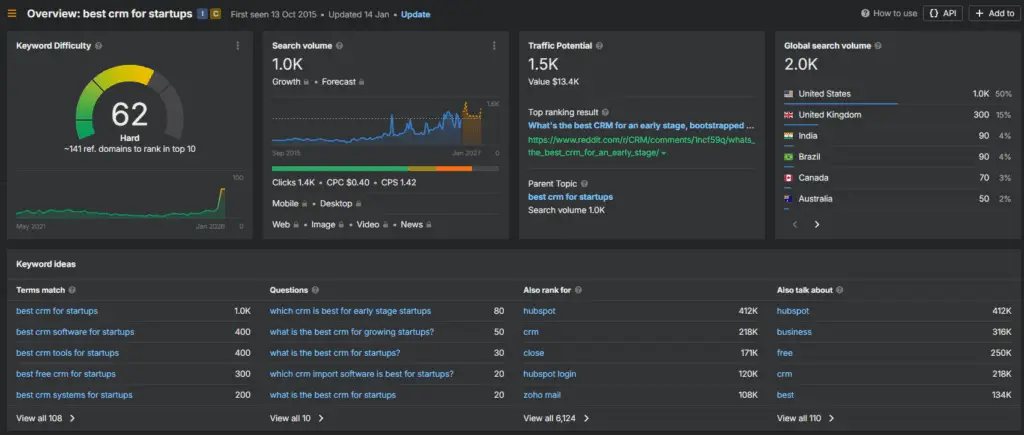
Map content types to specific buyer journey stages. Awareness stage prospects need problem-focused content that helps them understand their challenges. Consideration stage buyers require solution education comparing different approaches. Decision stage content includes detailed product comparisons, case studies with specific results, and technical documentation proving your solution works.
Don’t ignore top-funnel content entirely, but recognize it serves a different purpose. Broad educational content builds domain authority and attracts early-stage prospects who may convert 6-12 months later.
Allocate 70% of resources to middle and bottom-funnel content, 30% to awareness content.
Step 3: Build Your Content Production System
Consistent publishing beats sporadic genius. A content calendar keeps your team accountable and ensures steady progress toward traffic goals. Start with monthly planning sessions where you define topics, assign owners, and set publication dates.
Resource allocation decisions fundamentally impact quality and velocity. In-house content teams provide deep product knowledge and brand voice consistency but require significant investment.
SaaS SEO Freelancers offer flexibility and specialized expertise but need extensive onboarding. Agencies scale production quickly but often lack the technical depth for complex B2B SaaS topics.
Most early-stage companies start with a hybrid approach: internal strategy and editing with freelance execution. As you scale past $5M ARR, bringing content production in-house becomes cost-effective and improves quality.
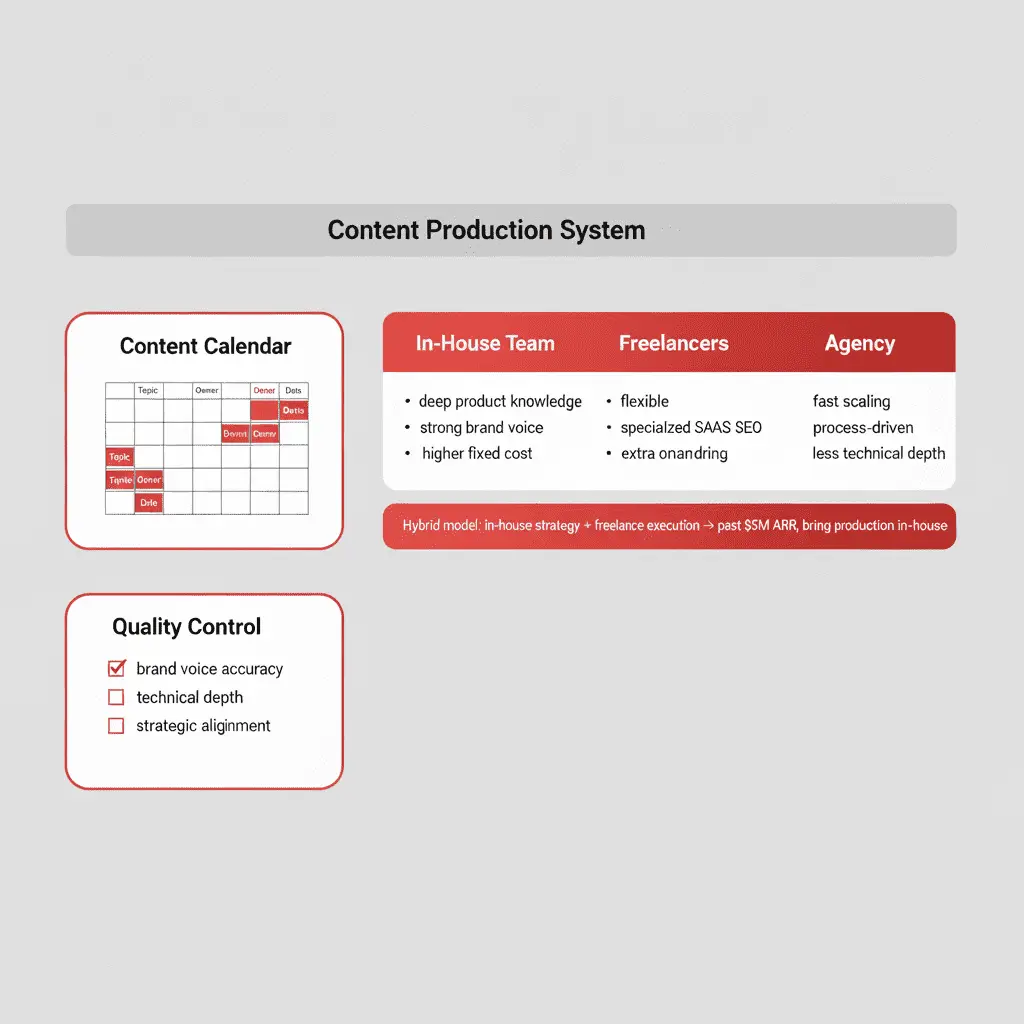
Quality control matters more in SaaS content marketing than almost any other industry.
Your prospects are educated, often technical buyers who spot shallow content instantly. Establish editorial standards covering brand voice, factual accuracy, technical depth, and strategic alignment.
Every piece should pass a simple test. Would your best customer forward this to a colleague?
Step 4: Optimize and Distribute for Maximum Reach
Technical SEO provides the foundation for content success. SaaS websites often face unique challenges. JavaScript rendering issues with React or Vue frontends, complex URL structures from product dashboards, and duplicate content from multi-tenant architectures. Fix these technical issues before investing heavily in content production.
On-page optimization for SaaS content follows proven principles. Include your target keyword in the H1, first 100 words, at least one H2, and meta description. Maintain keyword density between 0.5-0.8% without forcing unnatural phrasing. Structure content with clear headings that aid both scanning and search engine understanding.
Distribution determines whether your content reaches 100 people or 10,000. Multi-channel promotion starts with email nurture sequences delivering relevant content to prospects based on their stage and interests.
LinkedIn organic and paid promotion works particularly well for B2B SaaS, especially when founders and executives share content with their commentary.
Strategic partnerships amplify reach through complementary audiences. Guest posting on industry blogs, participating in expert roundups, and contributing to publications your prospects read all build authority while driving qualified traffic.
Step 5: Measure, Analyze, and Iterate
Track metrics that connect to revenue, not just traffic. Organic traffic growth matters, but conversion rate and pipeline influence determine content ROI.
For each major content piece, measure organic sessions, demo requests or trial signups attributed to that content, and opportunities influenced by content touchpoints.
Attribution modeling presents unique challenges for B2B SaaS given long sales cycles spanning 3-12 months with multiple touchpoints. First-touch attribution credits the initial discovery content, while last-touch credits the final conversion piece. Multi-touch attribution provides the most accurate picture, showing how different content pieces work together through the buyer journey.
Content refresh and optimization compounds results over time. High-performing content pieces deserve ongoing investment. Update statistics, add new sections covering recent developments, and improve technical SEO elements. A comprehensive guide updated quarterly often outperforms ten mediocre new posts.
Types of Content That Work Best for SaaS Companies
Different content formats serve different purposes in your saas content marketing strategy. Understanding the best content for your sales drives results and helps you allocate resources effectively.
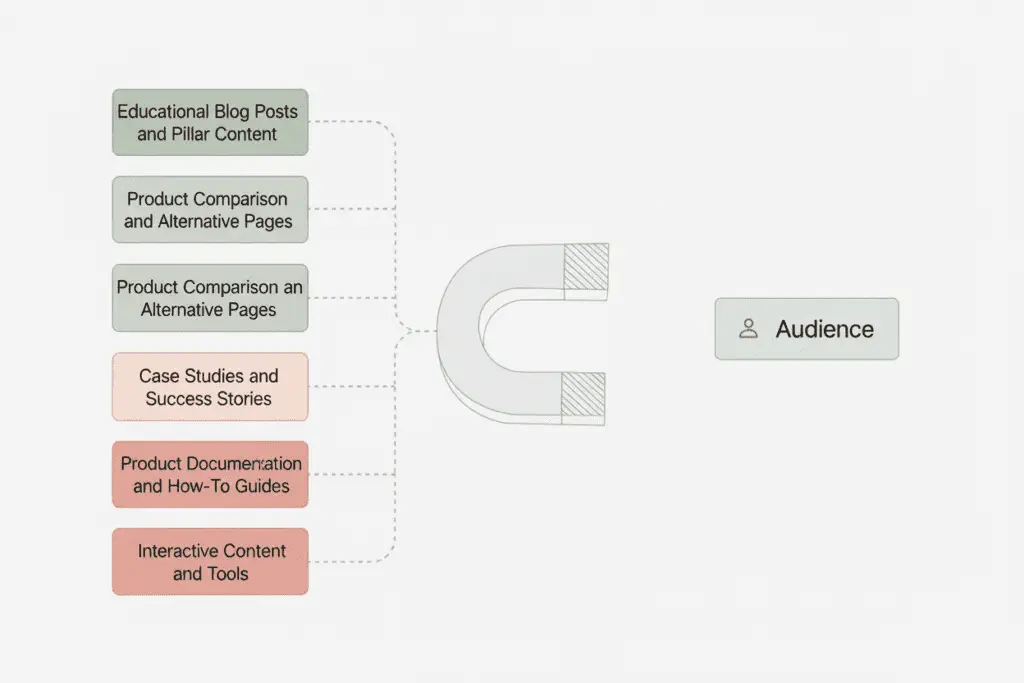
Educational Blog Posts and Pillar Content
In-depth guides establish authority and rank for competitive keywords. These comprehensive resources cover topics thoroughly, answering related questions in a single place.
Topic clusters build on pillar content by creating supporting articles that link back to the main guide, signaling topical authority to search engines.
Product Comparison and Alternative Pages
“[Competitor] Alternative” pages convert at exceptionally high rates because they target buyers actively evaluating solutions.
Be honest in these comparisons and acknowledge where competitors excel while clearly articulating your differentiation.
Prospects research alternatives anyway; controlling that narrative helps you win deals.
Case Studies and Customer Success Stories
Metrics-driven narratives prove your solution works in real-world scenarios. Structure case studies around specific challenges, your approach to solving them, and quantified results. Including perspectives from multiple stakeholders (end users, managers, executives) strengthens credibility.
Product Documentation and How-To Guides
Comprehensive documentation reduces time-to-value for new customers while delivering SEO benefits.
Help center articles targeting “how to [accomplish task]” queries attract users searching for solutions your product provides. This content converts particularly well for freemium and product-led growth models.
Interactive Content and Tools
ROI calculators, assessment tools, and free utilities generate qualified leads while providing genuine value. A mortgage SaaS might offer a free payment calculator, while a marketing platform could provide an SEO audit tool.
These assets work as lead magnets because they deliver immediate value before asking for significant information.
Conclusion: Transform Your SaaS Growth with Strategic Content
A content strategy for your SaaS business delivers sustainable growth by reducing customer acquisition costs, building brand authority, and creating compound returns over time.
Content marketing requires patience and consistent execution. Most B2B SaaS companies see meaningful results within 6-9 months, with traffic and conversions compounding thereafter. T
he companies that commit to strategic content for 12-18 months typically reduce CAC by 30-50% while building sustainable organic growth channels.
Ready to build your content marketing strategy? Book a call with me!
Frequently Asked Questions About SaaS Content Marketing
How to Measure SaaS Content Marketing?
Track metrics that tie directly to revenue: organic traffic growth, conversion rate from content to qualified leads, pipeline influenced by content touchpoints, and customer acquisition cost reduction. Use multi-touch attribution to understand how different content pieces work together across long B2B sales cycles. Set up goal tracking in Google Analytics for key conversion actions like demo requests, trial signups, and content downloads.
Best Tools for Content for SaaS?
Essential tools include Ahrefs or Semrush for keyword research and competitive analysis, Google Analytics 4 for traffic and conversion tracking, Google Search Console for search performance monitoring, and a robust CMS like WordPress or Webflow. Content creation benefits from Grammarly for editing, Hemingway for readability, and Canva or Figma for visuals. Marketing automation platforms like HubSpot or Marketo help distribute content and track engagement.
How Content Differentiates SaaS in Crowded Markets?
Content marketing establishes thought leadership by demonstrating deep understanding of customer problems and unique perspectives on solutions. Comprehensive educational resources position your brand as the go-to expert, making prospects naturally consider you when ready to buy. Original research, data-driven insights, and honest product comparisons build trust that paid advertising cannot match. In crowded markets, content quality and depth often matter more than product features alone.
How to Write SaaS Content?
Start with thorough audience research understanding your ICP’s specific challenges, goals, and decision criteria. Write for your actual audience. Whether that be technical content for developers or strategic content for executives.
Lead with specific outcomes rather than generic claims. Use real examples and data points to illustrate concepts. Structure content with clear headings, short paragraphs (2-3 sentences), and logical flow. Edit ruthlessly to eliminate jargon and fluff.
How to Create a Content Calendar for SaaS Growth?
Build your calendar around business objectives and keyword priorities. Start with quarterly planning identifying major themes and topics, then break down into monthly publication schedules.
Allocate 70% of content to bottom and middle-funnel topics that drive near-term conversions, 30% to top-funnel for authority building. Include promotion activities for each piece for email campaigns, social distribution, and partnership outreach. Review performance monthly and adjust priorities based on what drives results.
How to Create Engaging Blog Content for B2B SaaS?
Hook readers immediately with a specific problem, surprising statistic, or clear promise of value. Structure content for scanability using descriptive headings, bullet points for lists, and short paragraphs. Include real examples and case studies showing concepts in action. Address objections directly rather than ignoring concerns prospects have. End with clear next steps, whether that’s reading related content, requesting a demo, or trying your product.
How Often to Refresh SaaS Content for SEO?
High-performing content deserves quarterly or semi-annual updates to maintain rankings and relevance. Update statistics, add new sections covering recent developments, and improve examples with fresh case studies. Refresh content when you notice rankings dropping, when competitors publish superior content on the same topic, or when product changes make existing content outdated. A comprehensive guide updated twice yearly often outranks ten newer but never-updated articles.
