

How important is SEO in a SaaS business? Search engine optimization has become a critical growth driver for Software as a Service companies, yet many SaaS founders still question its true value compared to paid advertising channels. Recent data reveals compelling evidence that organic search not only delivers sustainable growth but also often outperforms paid channels in both cost-effectiveness and lead quality for SaaS businesses.
What Is SaaS SEO?
SaaS SEO refers to the strategic process of optimizing software-as-a-service websites and content to improve visibility in search engines for queries related to their specific software solutions. Unlike traditional SEO, SaaS SEO focuses on targeting decision-makers like CTOs, CEOs, and product managers who are actively researching software solutions to solve business problems.
The fundamental goal is to attract users who are searching for software solutions with high purchase intent, positioning your SaaS product as the preferred choice throughout their entire buyer journey. This approach differs significantly from general SEO tactics because it requires understanding complex B2B sales cycles, technical software features, and the specific language that potential customers use when evaluating software solutions.
The Current State of Search: Why SEO Matters More Than Ever
Google Search Continues to Dominate Despite AI Predictions
Contrary to widespread predictions that AI tools would significantly impact Google’s dominance, recent research from SparkToro reveals that Google search experienced remarkable growth in 2024. The data shows that Google processes over 14 billion searches daily, compared to ChatGPT’s 37.5 million searches per day – meaning Google receives approximately 373 times more searches than its leading AI competitor.
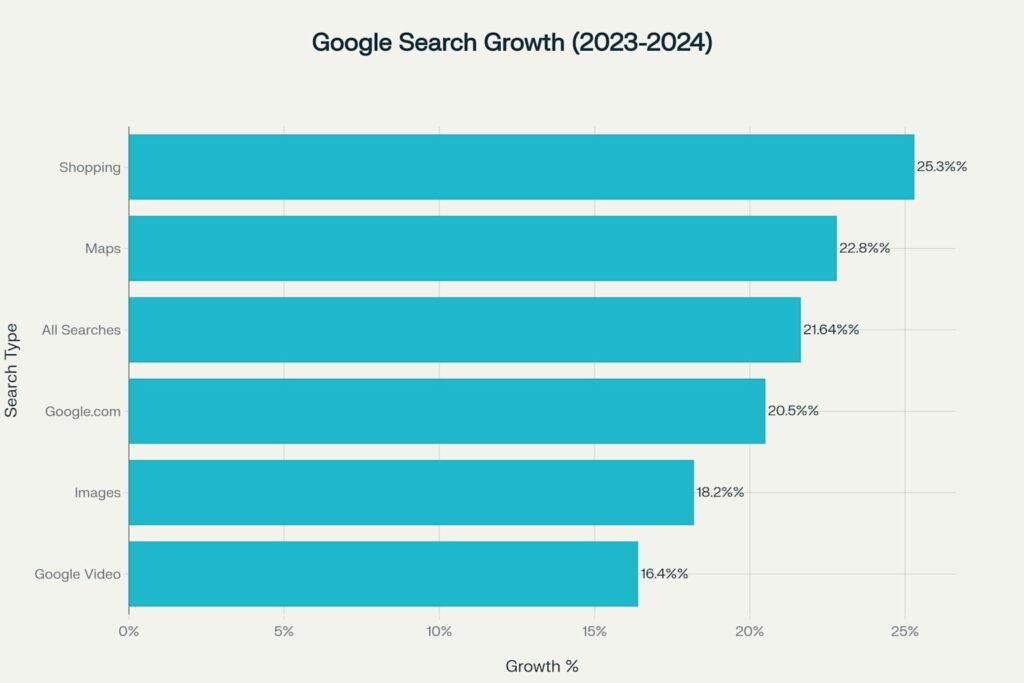
The growth spans across all Google search categories, with particularly strong performance in Google Shopping (25.3% growth) and Google Maps (22.8% growth). This data directly refutes claims that “SEO is dead” and demonstrates the continued importance of optimizing for traditional search engines.
AI Search Tools Represent Minimal Market Share
While generative AI tools like ChatGPT and Perplexity are gaining attention, their actual market share remains minimal compared to traditional search engines.
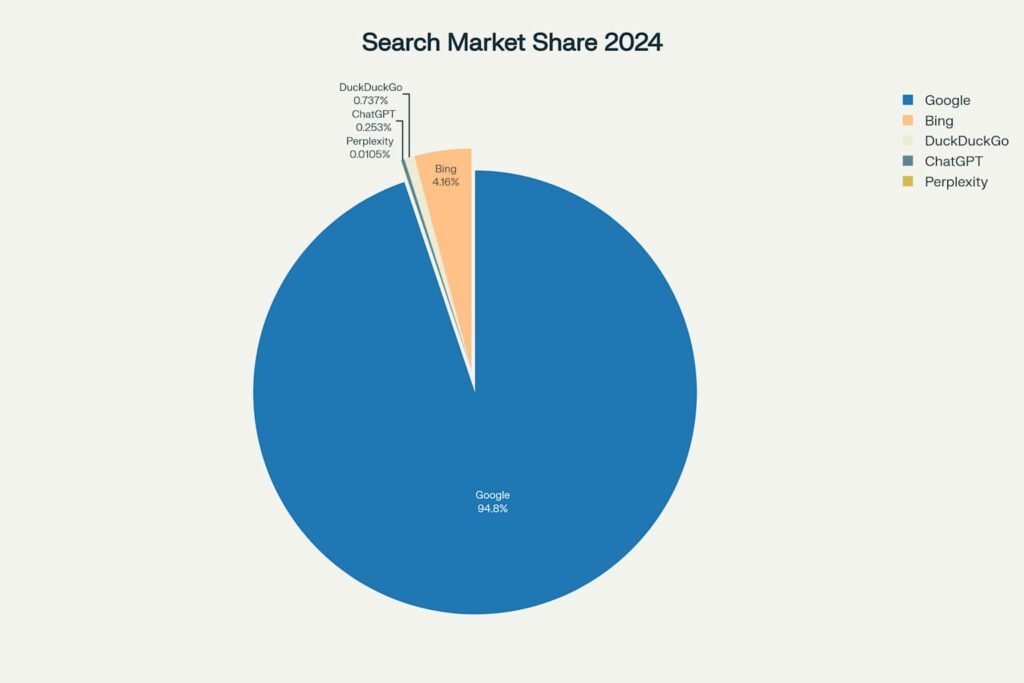
However, the emergence of Generative Engine Optimization (GEO) presents new opportunities for SaaS companies. GEO focuses on optimizing content to appear in AI-generated responses, but experts emphasize that traditional SEO must be optimized first to have any chance of ranking in generative AI results.
Why SEO Is Important for SaaS Business Success
1. Superior Lead Quality and Conversion Rates
Organic search consistently delivers higher-quality leads compared to paid advertising channels. Research shows that organic SEO leads convert at an 18.2% rate, slightly outperforming paid ads at 17.4%, but with significantly higher lead quality scores.
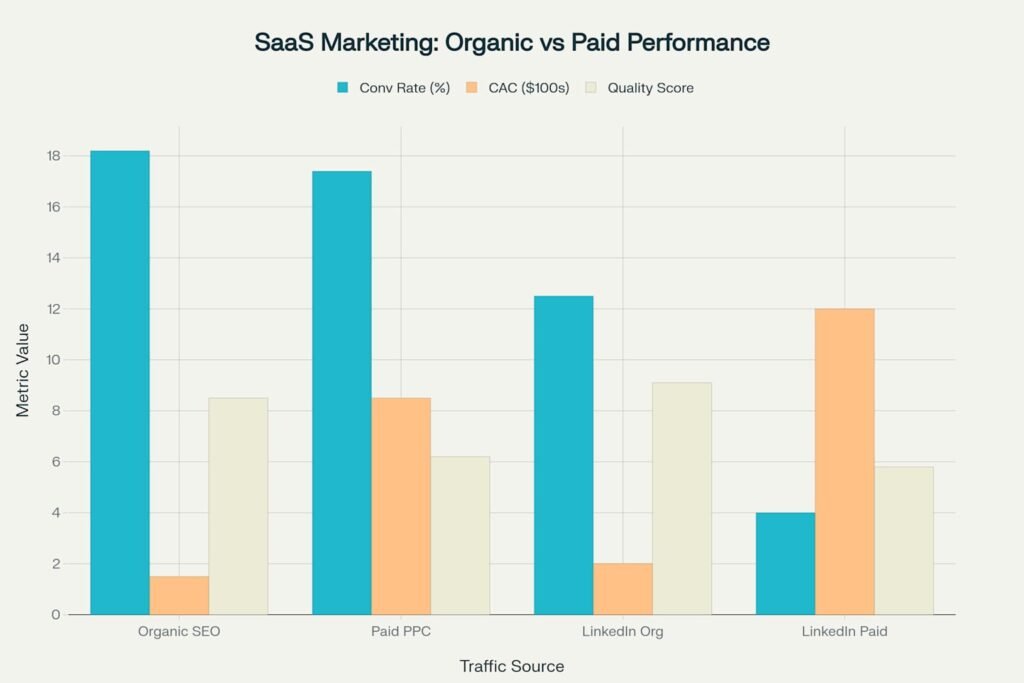
The superior performance becomes even more evident when examining customer acquisition costs. Organic leads typically cost around $150 to acquire, while paid advertising can cost $850 or more per customer acquisition. This dramatic difference in cost efficiency makes SEO particularly attractive for SaaS companies operating with limited marketing budgets.
2. Long-term Compound Growth vs. Rental Marketing
Unlike paid advertising, which stops generating results the moment you stop spending, SEO creates compound growth over time. Industry experts describe this difference as “paid ads = rent, organic LinkedIn = equity”. SaaS websites can achieve over 1 million impressions within 6-12 months through SEO alone, without ongoing ad spend.
3. Supporting the Complete Buyer Journey
SaaS SEO excels at supporting customers throughout their entire buying journey, from initial awareness to final purchase decision. The marketing funnel approach allows SaaS companies to create targeted content for each stage:
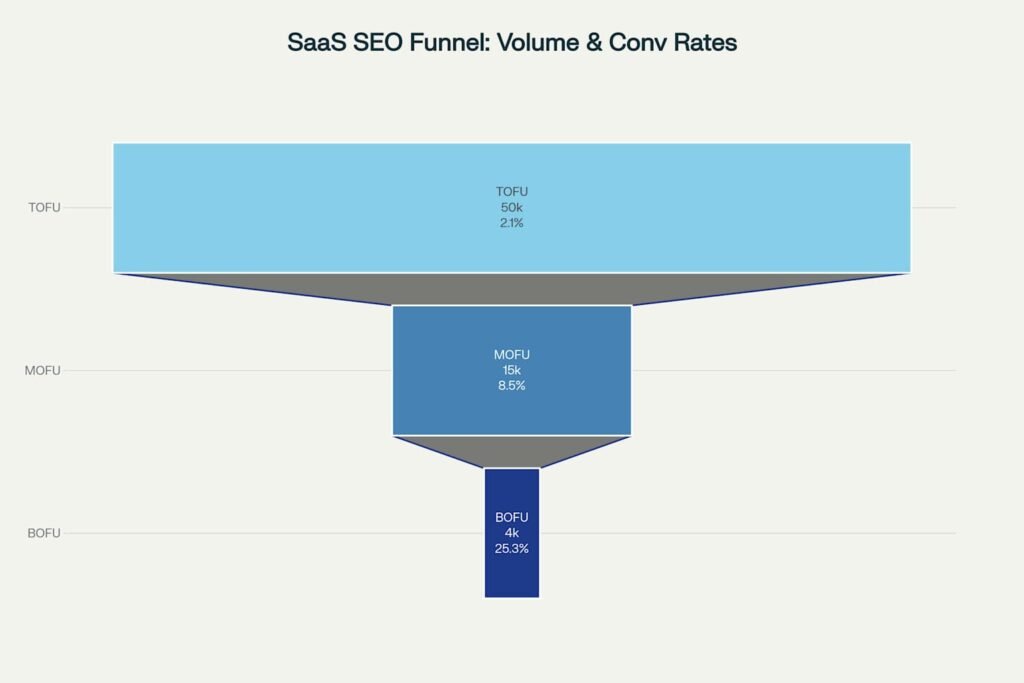
Top of Funnel (TOFU): Content targeting awareness-stage keywords with high search volume but lower competition, such as “what is project management” or “team collaboration benefits”.
Middle of Funnel (MOFU): Comparison and evaluation content targeting users researching specific solutions, like “project management software comparison” or “best CRM for small businesses”.
Bottom of Funnel (BOFU): High-intent commercial content targeting users ready to make purchasing decisions, such as “project management software pricing” or “CRM software demo”.
4. Building Authority and Trust
Consistent organic visibility builds brand authority and trust more effectively than paid advertising. When potential customers consistently see your content in organic search results, it positions your company as a thought leader and trusted authority in your space. This is particularly important for SaaS companies, where trust and credibility are essential factors in enterprise software purchasing decisions.
How to Improve SEO for SaaS Companies
Strategic Keyword Research for SaaS
Effective SaaS keyword research requires understanding your ideal customer profile (ICP) and mapping keywords to different stages of the buyer journey. The process involves:
- Brainstorming seed topics based on customer touchpoints and common questions from sales and support teams
- Analyzing competitor keywords to identify gaps and opportunities
- Prioritizing keywords based on search volume, competition level, and business relevance
For more detailed guidance on this process, see my comprehensive guide on how to do keyword research for SEO.
Content Creation Strategy
SaaS SEO success requires creating high-quality, helpful content that addresses specific user needs at each funnel stage. Key content types include:
- Educational blog posts answering common industry questions
- Comparison pages evaluating your solution against competitors
- Feature-focused landing pages explaining specific product capabilities
- Case studies demonstrating real customer success stories
Learn more about creating effective SEO content on my guide on how to write SEO content.
Technical SEO Optimization
SaaS websites must prioritize technical SEO elements including site speed, mobile optimization, and proper site architecture. With Google’s mobile-first indexing, ensuring your SaaS platform performs excellently on mobile devices is critical.
Competitive Analysis
Understanding your competitors’ SEO strategies provides valuable insights for your own campaigns. Conducting regular SEO competitive analysis helps identify content gaps, keyword opportunities, and backlink prospects.
Preparing for Generative AI Search
As generative AI tools gain adoption, SaaS companies should prepare for generative engine optimization. This involves:
- Creating conversational, FAQ-style content
- Structuring content for featured snippets
- Optimizing for voice search queries
- Building topical authority through comprehensive content coverage
For specific guidance on this emerging area, explore my article on how to rank in AI search engines.
ROI and Financial Impact of SaaS SEO
Cost-Effectiveness Compared to Paid Advertising
The financial case for SaaS SEO is compelling when compared to paid advertising alternatives. Average cost-per-click rates for SaaS keywords can range from $35-$60 for bottom-of-funnel terms, making paid campaigns expensive to maintain.
In contrast, once SEO rankings are established, the ongoing costs are primarily related to content creation and maintenance rather than per-click payments. This creates a significant long-term cost advantage for companies that invest in organic search optimization.
Higher Lifetime Value and Retention
Customers acquired through organic search typically demonstrate higher lifetime values and better retention rates. The research process involved in organic discovery often means these customers have a deeper understanding of your product’s value proposition before making contact, leading to better product-market fit and reduced churn.
Measurable Business Impact
SaaS companies implementing comprehensive SEO strategies report significant business impact. Key metrics include:
- 57% of organic traffic comes from organic search for typical SaaS companies
- 9% conversion rate from marketing qualified leads to closed-won customers
- 20-35% faster sales cycles for organic leads compared to paid ad leads
For real-world examples of SEO success, explore my case studies showcasing how businesses have achieved significant growth through strategic SEO implementation.
Getting Started with SaaS SEO
For SaaS companies ready to invest in organic search optimization, the key is developing a systematic approach that aligns with business objectives. Start by:
- Conducting an SEO audit to identify current strengths and weaknesses
- Defining your ideal customer profile and understanding their search behavior
- Developing a content strategy that addresses each stage of the buyer journey
- Implementing technical optimizations to ensure search engine accessibility
- Building a consistent content creation schedule to establish topical authority
Consider starting with a free SEO video audit to understand your current position and identify the highest-impact opportunities for improvement.
For SaaS startups specifically, early investment in SEO can provide significant competitive advantages. Learn more about this approach in our guide to SEO for SaaS startups.
Conclusion
The data overwhelmingly supports SEO as a critical growth channel for SaaS businesses. With Google search continuing to grow despite AI predictions, superior lead quality compared to paid channels, and significant cost advantages over time, SEO represents one of the most effective long-term investments SaaS companies can make.
The key to success lies in understanding that SaaS SEO requires a strategic, long-term approach focused on creating valuable content that serves your ideal customers throughout their entire buying journey. While results may take 6-12 months to fully materialize, the compound growth effects and cost savings make this investment worthwhile for most SaaS companies.
As the search landscape continues evolving with AI integration, SaaS companies that establish strong organic search foundations today will be best positioned to adapt and thrive in the future search environment.
