

Look, I’m just going to say it.
Most SaaS companies are sitting on a goldmine of potential customers, but their website copy is actively pushing people away.
I see it all the time. Beautiful product. Solid tech. But when I land on their homepage? Jargon soup. Vague promises. Zero emotional connection. The kind of copy that makes people bounce faster than a rubber ball on concrete.
Here’s the thing: SaaS SEO copywriting isn’t just about ranking on Google (though that matters). It’s about writing words that make people feel something, understand your value instantly, and actually hit that “Start Free Trial” button.
I’m Ricardo Rodriguez, and I’ve spent years helping SaaS companies turn their content from “meh” to “hell yes.” I’ve seen firsthand what happens when you combine strategic SEO with conversion-focused copy. Traffic goes up, sure, but more importantly, signups skyrocket.
In this guide, I’m breaking down everything you need to know about finding (or becoming) a SaaS SEO copywriter who actually gets results. No fluff. No corporate BS. Just the stuff that works.
What Makes a SaaS SEO Copywriter Different from Regular Copywriters
Let’s clear this up right now.
Your cousin who writes blog posts about gardening? Not a SaaS SEO copywriter.
That agency that promises to “optimize your content”? Maybe. But probably not specialized enough.
SaaS SEO copywriting is a weird hybrid skill. You need to understand:
- SaaS business models (MRR, churn, LTV, the whole acronym circus)
- SEO technical stuff (keyword research, search intent, schema markup)
- Conversion psychology (what makes B2B buyers actually pull the trigger)
- The SaaS buyer journey (which is long, complex, and involves like 47 stakeholders)
Most copywriters have one, maybe two of these. A real SaaS SEO copywriter? They’ve got all four on lock.
The Triple Threat: SEO + Conversion + SaaS Expertise
Here’s what separates the pros from the pretenders:
1. They Actually Understand Your Business Model
A SaaS SEO copywriter gets that you’re not selling a one-time product. You’re asking people to commit to a monthly relationship. That changes everything about how you write.
They know your real challenge isn’t just getting signups. It’s getting signups that stick around, upgrade, and become advocates.
2. They Write for Search Engines AND Humans
Anyone can stuff keywords into an article. A fifth-grader with a thesaurus can do that.
But writing copy that ranks and converts? That’s the magic. It means understanding search intent, crafting headlines that make people click, and structuring content so both Google and your CEO are happy.
According to HubSpot’s latest research, businesses prioritizing SEO are 13x more likely to see positive ROI. But only if the content actually does something once people arrive.
3. They Know the Difference Between Features and Outcomes
Here’s a test: Look at your homepage right now.
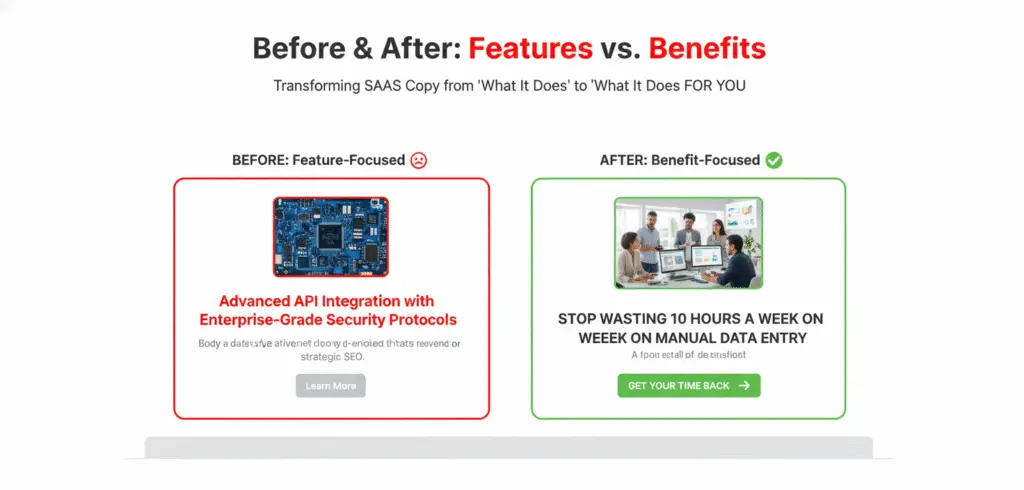
Does it say “Advanced API integration with enterprise-grade security protocols”?
Or does it say “Stop wasting 10 hours a week on manual data entry”?
The first is a feature. The second is an outcome people actually care about.
SaaS SEO copywriters obsess over outcomes. Because that’s what makes people buy.
Why SaaS Companies Desperately Need Specialized Copywriters
The SaaS market hit $250 billion globally in 2025, according to Statista. That’s not a typo.
Competition is absolutely brutal. There are probably 47 other companies doing basically the same thing you do.
So how do you stand out?
Not with better features. Everyone’s got “AI-powered” something-or-other now.
Not with lower prices. Race to the bottom = death spiral.
You stand out with better messaging. With copy that makes people think “holy crap, they get me.”
The Content Marketing Reality for SaaS
Here’s some data that should wake you up:
Research from Campfire Labs analyzing 500+ SaaS companies found:
- Average organic traffic growth: 24% year-over-year
- Marketing software companies: 6% month-over-month growth
- Developer tools: 5% MoM growth
- Customer service software: 1% MoM (super competitive)
But here’s the kicker: These are just averages.
Companies with killer SEO copy? They’re crushing these numbers. Companies with mediocre copy? They’re stuck at the bottom, wondering why their “content strategy” isn’t working.
The Conversion Rate Gap
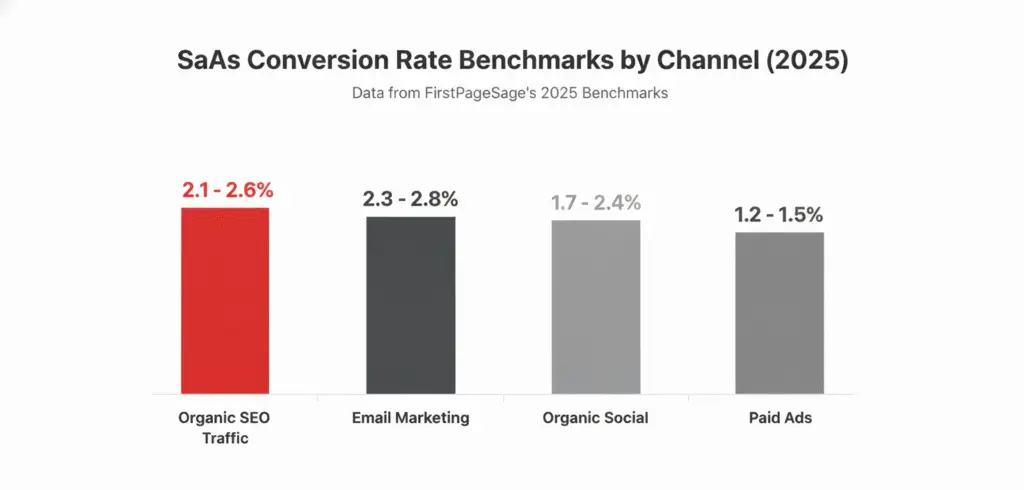
According to FirstPageSage’s 2025 benchmarks, here’s what conversion rates look like across channels for SaaS:
- SEO traffic: 2.1-2.6% conversion rate
- Paid ads: 1.2-1.5% conversion rate
- Email: 2.8-2.4% conversion rate
- Organic social: 2.4-1.7% conversion rate
Notice something? Organic SEO traffic converts better than paid ads.
But only if your copy doesn’t suck.
If people land on your page and see corporate word salad, they’re gone. Doesn’t matter how well you ranked.
The SaaS SEO Copywriting Framework That Actually Works
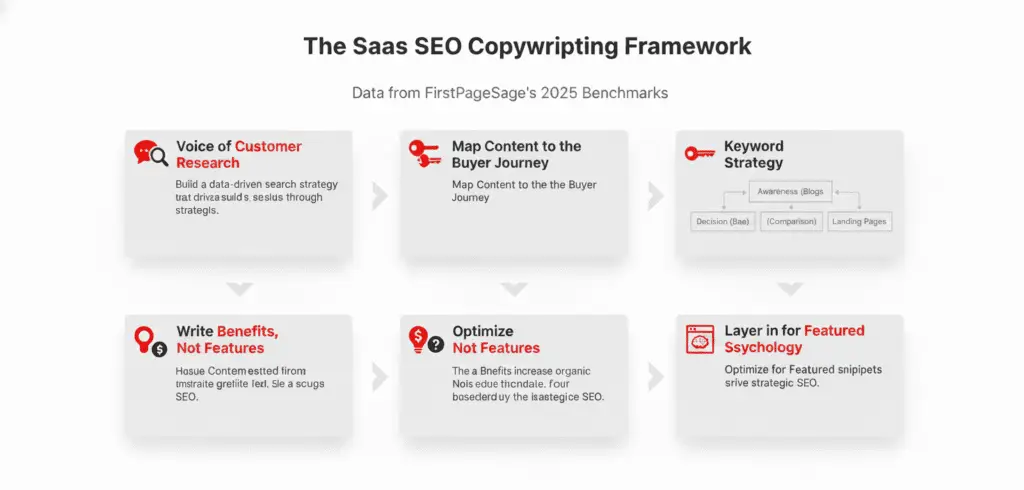
Alright, let’s get tactical.
This is the framework I use with every SaaS client. It’s not rocket science, but it works.
Step 1: Voice of Customer Research (The Foundation Everything Builds On)
Before you write a single word, you need to know how your customers actually talk.
Not how you think they talk. Not how your product team talks. How your actual customers describe their problems.
Here’s where to find this gold:
- Customer support tickets (pain points galore)
- Sales call recordings (objections, questions, language patterns)
- G2 and Capterra reviews (both yours and competitors’)
- Reddit threads in your industry
- YouTube video comments on competitor content
- LinkedIn posts from your target personas
I spend about 80% of my time on research and only 20% actually writing. Sounds backwards, right?
But when you nail the research, the writing practically writes itself. Because you’re using their words to describe their problems.
Step 2: Map Content to the Buyer Journey
SaaS buyers don’t wake up one morning and subscribe to your $500/month platform.
They go through stages. Your copy needs to meet them where they are.
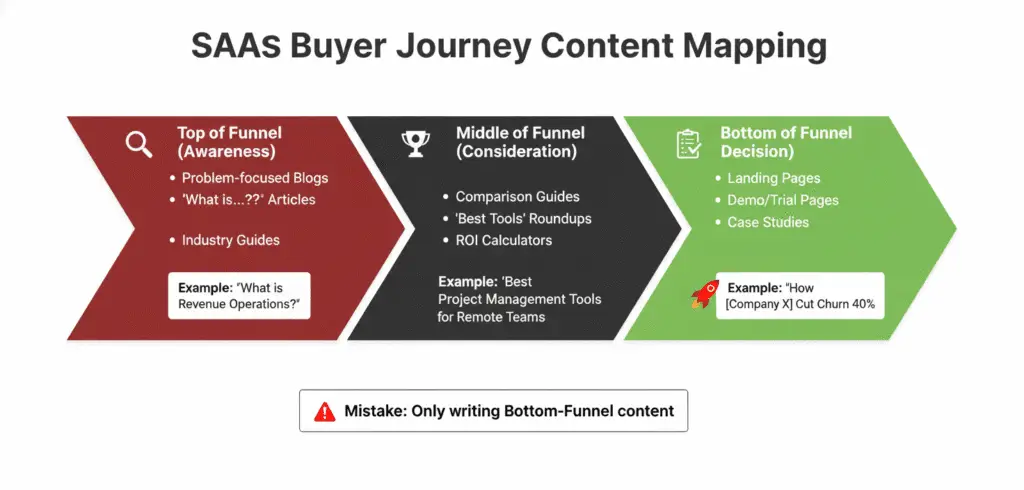
Top of Funnel (Awareness Stage):
- Problem-focused blog content
- “What is [topic]” articles
- Industry trend analysis
- Educational resources
Example: “What is Revenue Operations?” (Not “Why Our RevOps Tool is Amazing”)
Middle of Funnel (Consideration Stage):
- Comparison guides
- “Best [category] tools” roundups
- Use case deep-dives
- ROI calculators
Example: “Best Project Management Tools for Remote Teams” (Include yourself, obviously)
Bottom of Funnel (Decision Stage):
- Landing pages optimized for conversions
- Demo booking pages
- Free trial signup flows
- Case studies with actual numbers
Example: “See how [Company X] reduced churn by 40% in 90 days”
Most SaaS companies make the mistake of writing only bottom-funnel content. Then they wonder why they’re not getting enough traffic.
Or they write only top-funnel content and wonder why traffic doesn’t convert.
You need all three. Working together.
Step 3: Keyword Strategy That Balances Traffic and Intent
Here’s the deal with keywords: Volume doesn’t mean jack if people don’t convert.
I’d rather rank for a keyword that gets 100 searches a month with 5% conversion rate than one that gets 10,000 searches with 0.1% conversion.
How to find high-intent keywords:
- Start with your ideal customer’s actual search queries (ask your sales team what people Google before calling)
- Look for long-tail variations (“best CRM for real estate teams under $100/month” vs. just “CRM software”)
- Prioritize buyer-intent keywords over researcher-intent (people comparing solutions vs. people writing school papers)
- Check the SERP before committing (if it’s all listicles, write a listicle; if it’s all guides, write a guide)
Tools like Ahrefs and SEMrush are great for this. But honestly? Sometimes the best insights come from just listening to sales calls.
Step 4: Write Benefits, Not Features (This Is Where Most SaaS Copy Dies)
I cannot stress this enough.
Nobody cares about your features.
They care about what your features do for them.
Let me show you the difference:
Feature-focused (bad): “Our platform includes advanced Salesforce API integration with real-time bidirectional sync capabilities.”
Benefit-focused (good): “Your sales team stops wasting 2 hours a day on manual data entry. Every lead automatically flows into Salesforce. No copy-paste, no missed opportunities.”
See the difference?
One talks about technical specs. The other talks about getting back 10 hours a week.
Quick framework for translating features to benefits:
- Write down the feature
- Ask “so what?”
- Ask “so what?” again
- Keep asking until you hit an emotional outcome
Example:
- Feature: “99.9% uptime SLA”
- So what? “Your app doesn’t go down”
- So what? “Your customers don’t get frustrated”
- So what? “You don’t lose customers (and revenue) to outages” ← There’s your benefit
Step 5: Optimize for Featured Snippets and Answer Boxes
Google’s trying to answer questions without people clicking anymore. 58.5% of searches now end without a click, according to recent data.
That sounds terrible, right?
Actually, it’s an opportunity.
If you structure your content to win featured snippets, you get massive visibility and the people who do click are super high-intent. This is especially important as AI Overviews continue to change search behavior.
How to optimize for featured snippets:
- Answer questions directly in the first 40-60 words
- Use clear definition paragraphs for “what is” queries
- Create bulleted lists for “best” or “top” queries
- Use numbered steps for “how to” queries
- Add tables for comparison queries
- Implement FAQ schema (more on this below)
I’ve seen clients get 30-40% of their organic traffic from featured snippets alone. It’s not magic, it’s just strategic formatting.
Step 6: Layer in Conversion Optimization Psychology
SEO gets people to your page. Conversion psychology gets them to act.
Here are the psychological triggers that actually work for SaaS:
Social Proof (The Big One)
- Customer logos (recognizable brands = instant credibility)
- G2/Capterra ratings (third-party validation)
- Testimonials with specifics (“increased demos by 67%”)
- Case studies with real numbers
- User counts (“Join 10,000+ teams”)
Research shows 83% of marketers say social proof outperforms most other conversion tactics on landing pages.
Reciprocity
- Free tools (ROI calculators, templates, assessments)
- Educational content (webinars, guides, whitepapers)
- No-credit-card trials
Give value upfront. People feel obligated to reciprocate.
Authority Signals
- Certifications (SOC 2, ISO 27001, etc.)
- Founder credentials (ex-Google, ex-Salesforce)
- Media mentions (Forbes, TechCrunch)
- Partnerships (Salesforce partner, HubSpot integration)
Scarcity and Urgency (Use Carefully)
- Limited-time pricing
- Beta access (exclusive positioning)
- Countdown timers for promotions
But be real about it. 41% of marketers warn against fake deadline fatigue. If you’re going to use urgency, make it legit.
Risk Reversal
- Money-back guarantees
- No-credit-card trials
- Cancel anytime (and actually mean it)
- Migration assistance
The easier you make it to try and leave, the more people will try (and stick around).
What to Look for When Hiring a SaaS SEO Copywriter
Looking to hire a SaaS SEO copywriter? Here’s your checklist.
The Non-Negotiables
1. They Have Actual SaaS Experience
Ask for portfolio samples. Specifically SaaS samples.
If they send you e-commerce product descriptions or restaurant menu copy, run.
2. They Understand SEO Beyond “Use Keywords”
They should be able to explain:
- Search intent and how it varies by funnel stage
- How to structure content for featured snippets
- Basic technical SEO (schema markup, internal linking, etc.)
- How to analyze SERP to inform content strategy
If they can’t, they’re just a writer with an SEO certificate from some random course.
3. They Can Show Results (Not Just Pretty Words)
Pretty copy means nothing if it doesn’t perform.
Ask for:
- Traffic improvements (with proof)
- Conversion rate lifts
- Ranking improvements
- Actual business impact (signups, demos, revenue)
Good copywriters keep receipts.
4. They Ask About Your Customers Before They Ask About Your Product
If a copywriter starts with “Tell me about your features,” that’s a yellow flag.
If they start with “Tell me about your customers’ biggest frustrations,” that’s green.
The best SaaS SEO copywriters are obsessed with customer research. Because that’s where all the magic lives.
The Nice-to-Haves
- Experience in your vertical (fintech, healthcare SaaS, etc.)
- Understanding of your specific GTM motion (PLG vs. sales-led)
- Data literacy (can read Google Analytics, understand metrics)
- Technical writing chops (if your product is complex)
Red Flags to Watch Out For
They promise rankings without seeing your site Nobody can guarantee rankings. Google doesn’t work that way.
They talk exclusively about traffic, not conversions Traffic is vanity. Revenue is sanity.
They send you a price list without asking questions Good copywriting is custom work. Template pricing = template results.
They don’t mention research or customer insights If they’re not asking about your customers, they’re going to write generic fluff.
Their own website has terrible copy The cobbler’s children should have shoes. If their site is weak, that’s telling.
The ROI of Actually Good SaaS SEO Copy
Let’s talk numbers. Because at the end of the day, you’re running a business.
Scenario: Mid-market SaaS company
- Current organic traffic: 10,000/month
- Current conversion rate: 1.5%
- Current signups: 150/month
- Trial-to-paid conversion: 20%
- Average LTV: $5,000
Current monthly value from organic: 150 signups × 20% conversion × $5,000 LTV = $150,000 in customer LTV per month
After hiring a good SaaS SEO copywriter:
- Organic traffic: 15,000/month (+50% over 6 months)
- Conversion rate: 2.5% (+67% through better copy)
- Signups: 375/month (+150%)
- Trial-to-paid: 25% (+25% through better onboarding copy)
New monthly value from organic: 375 signups × 25% conversion × $5,000 LTV = $468,750 in customer LTV per month
Difference: $318,750/month in additional customer LTV
Even if you pay a premium copywriter $5,000-$10,000/month, the ROI is ridiculous.And these aren’t made-up numbers. Research from Promodo’s 2025 SaaS benchmarks shows that companies with segmented, optimized content see 28.2% organic traffic increases vs. just 1.8% for unsegmented approaches.
Common SaaS Copywriting Mistakes (And How to Avoid Them)
I’ve audited probably 200+ SaaS websites at this point.
Here are the mistakes I see over and over:
Mistake #1: Talking About Yourself Instead of the Customer
Bad: “We’re the leading AI-powered platform for…” Good: “You’re tired of tools that promise automation but still require 10 hours of setup…”
Start with their problem. Not your solution.
Mistake #2: Burying the Value Proposition
Your homepage header should pass the “5-second test.”
If I can’t figure out what you do and why I should care in 5 seconds, you’ve lost me.
Clear value prop example: “Turn messy spreadsheets into automated workflows, no code required”
Vague value prop example: “Empowering teams to achieve digital transformation through innovative solutions”
See the difference?
Mistake #3: Assuming People Understand Your Industry Jargon
You live and breathe your product. Your customers don’t.
Terms like “API,” “webhooks,” “serverless architecture”, those might as well be Klingon to most buyers.
Either explain them or find simpler language.
Mistake #4: Writing Everything for Bottom-Funnel (Ready to Buy) Readers
Most people aren’t ready to buy on their first visit.
They’re researching. Learning. Comparing.
If all your content is “Sign up now!” you’re missing 95% of potential customers. This is one of the most common SaaS SEO mistakes I see companies make.
Mistake #5: Ignoring Mobile Users
Over 60% of B2B research happens on mobile now.
If your copy requires a desktop screen to parse, you’re alienating more than half your audience.
Mobile-friendly copy checklist:
- Short paragraphs (2-3 sentences max)
- Clear headings that work as signposts
- Bullet points for scannability
- No endless walls of text
- Fast-loading pages (copy loads fast even if images don’t)
Mistake #6: Not Testing Anything
You wouldn’t launch a product without testing it, right?
So why launch copy without testing?
Even simple A/B tests on headlines, CTAs, or value props can yield 20-30% conversion improvements.
How I Approach SaaS SEO Copywriting Projects
Want to know how this actually works in practice? Let me walk you through my process.
Phase 1: Deep-Dive Research (Week 1-2)
I’m basically Sherlock Holmes at this point.
What I’m looking at:
- 10-15 customer interviews (recorded sales calls or actual interviews)
- Support ticket analysis (what questions come up repeatedly?)
- Competitor content audits (what’s working? what gaps exist?)
- Keyword research (high-intent opportunities)
- Analytics review (what content already converts? what doesn’t?)
I take detailed notes on language patterns, pain points, objections, and emotional drivers.
This research doc usually ends up 30-40 pages. No joke.
Phase 2: Strategy Development (Week 2-3)
Based on research, I map out:
Content Opportunities by Funnel Stage
- Top-funnel topics (awareness, education)
- Mid-funnel topics (comparison, consideration)
- Bottom-funnel assets (conversion-focused pages)
Keyword Targeting Strategy
- Primary keywords by content piece
- Secondary and LSI keywords
- Internal linking structure
- Content cluster strategy
Messaging Architecture
- Core value proposition
- Key differentiators
- Proof points and social proof strategy
- Objection handling
Conversion Optimization Plan
- CTA variations to test
- Social proof placement
- Risk reversal elements
- Page structure recommendations
Phase 3: Content Production (Week 3-8)
Now the actual writing happens. Finally.
But because the research is solid, this part goes fast.
Typical project includes:
- Homepage rewrite (hero section, value prop, key sections)
- 4-6 core landing pages (features, use cases, etc.)
- 8-12 blog posts (mix of funnel stages)
- Email nurture sequences
- Demo/trial page optimization
Each piece goes through multiple rounds:
- First draft (getting ideas down)
- SEO optimization (keyword integration, structure)
- Conversion optimization (CTAs, social proof, flow)
- Client feedback and revision
- Final polish
Phase 4: Implementation and Optimization (Ongoing)
Launch isn’t the end. It’s the beginning.
What I track:
- Organic traffic by page
- Keyword rankings
- Conversion rates by page
- Time on page / engagement metrics
- Backlinks earned
- Featured snippet wins
Then we iterate. Test new headlines. Try different CTAs. Refine messaging.
The best SaaS SEO copy is never “done”, it’s continuously improving based on data.
The AI Factor: Will Robots Replace SaaS SEO Copywriters?
Let’s address the elephant in the room.
ChatGPT, Claude, and other AI tools can write copy now. Fast. Cheap. At scale.
So are SaaS SEO copywriters screwed?
Nah.
Here’s why:
AI Is a Tool, Not a Replacement
I use AI tools every single day. For:
- Research assistance (summarizing customer reviews)
- Ideation (brainstorming headline variations)
- Structural outlining (organizing complex topics)
- First-draft speed (getting ideas down faster)
But the AI doesn’t replace the strategic thinking, customer empathy, or brand voice nuance that makes copy actually work.
According to the Content Marketing Institute’s 2025 research, 87% of marketers are using AI for content, but only 39% report improved performance.
Why? Because AI-generated content often lacks:
- Authenticity and unique perspective
- Deep customer understanding
- Strategic positioning
- Emotional resonance
- Brand voice consistency
The Authenticity Premium
Here’s what’s happening: AI content is flooding the internet.
And audiences are getting really, really good at spotting it.
The generic, templated, “here are 5 tips” content that sounds like it was written by a committee of robots? People scroll right past it.
But content that sounds like a real human with real experience? That stands out more than ever.
Paradoxically, AI is making human copywriters more valuable, not less.
The ones who can combine AI efficiency with human insight? They’re crushing it.
How I Use AI Without Letting It Replace Strategy
My approach:
- Use AI for speed (research, outlines, first drafts)
- Use human judgment for strategy (what to write, how to position, what matters)
- Use human editing for voice (make it sound like me, not a robot)
- Use human experience for insights (the stuff AI can’t know)
Bottom line: If you’re just pumping out AI content with minimal editing, you’re commoditizing yourself.
If you’re using AI as a tool within a strategic, human-led process? You’re unstoppable.
SaaS SEO Copywriting: Industry-Specific Considerations
Not all SaaS is created equal. The copy that works for a marketing automation tool won’t work for healthcare compliance software.
B2B vs B2C SaaS
B2B SaaS copywriting:
- Longer sales cycles (months, not minutes)
- Multiple stakeholders (you’re convincing 5-10 people, not one)
- ROI-focused messaging (CFOs want numbers)
- Trust and credibility paramount (risk aversion is real)
- Technical depth expected (buyers do research)
B2C SaaS copywriting:
- Faster decisions (often same-day signups)
- Individual buyers (convince one person)
- Emotion and aspiration (how will this make my life better?)
- Simplicity wins (don’t make me think)
- Free trials critical (let me play with it)
Vertical SaaS Specialization
The vertical SaaS market is $157.4 billion and growing at 23.9% CAGR, according to industry research.
Why? Because generic horizontal platforms can’t compete with industry-specific solutions that speak the language and understand the workflows.
If you’re writing for vertical SaaS, you need to:
- Use industry-specific terminology correctly (healthcare SaaS is different from legal SaaS)
- Understand compliance requirements (HIPAA, SOC 2, GDPR, whatever applies)
- Know the workflows you’re improving (can’t write about construction project management without understanding construction)
- Address industry-specific pain points (generic pain points won’t cut it)
This is where specialization really pays off. A copywriter who gets your vertical is worth 10x someone who’s just “good at SaaS.”
For example, if you’re in the fintech space, you need someone who understands fintech marketing strategies and can speak to the unique challenges of financial services SaaS.
PLG (Product-Led Growth) vs Sales-Led
Product-Led Growth (like Slack, Notion, Figma):
- Copy focuses on ease of use and quick wins
- Free tiers and viral loops emphasized
- Self-serve onboarding (the product sells itself)
- Social proof from users, not executives
- Bottom-up adoption messaging
Sales-Led (like Salesforce, SAP, enterprise software):
- Copy focuses on ROI and business outcomes
- Demo requests and sales consultation CTAs
- White-glove onboarding mentioned
- Executive-level social proof (CIO testimonials)
- Top-down decision-making messaging
Get this wrong and your copy falls flat.
Ready to Actually Fix Your SaaS Copy?
Here’s the deal.
You can keep doing what you’re doing. Writing copy in-house between meetings. Hoping it works. Watching competitors pull ahead.
Or you can work with someone who’s been in the trenches and knows what actually converts.
I currently work with a limited number of SaaS clients on copywriting and content strategy projects. If you’re serious about improving your messaging and growing organic revenue, let’s talk.
Here’s what working together typically looks like:
- Discovery call (no charge, no obligation.Just a real conversation about your business)
- Content audit (if needed, I’ll review what you have and identify opportunities)
- Custom proposal (tailored to your specific goals and budget)
- Collaborative process (I’m part of your team, not some vendor you never hear from)
I don’t do one-size-fits-all packages. Every SaaS business is different.
But if you’re ready to invest in copy that actually performs, reach out here.
Bottom Line: SaaS SEO Copy That Actually Converts Is Worth It
Look, I get it. Investing in professional copywriting feels like a luxury.
Especially when you’ve got 47 other things competing for budget.
But here’s what I’ve seen over and over: the companies that invest in great copy grow faster. Period.
They rank higher. They convert better. They build stronger brands.
And the companies that cheap out on copy? They wonder why their beautiful product isn’t getting traction.
The SaaS market is only getting more competitive. You can’t out-feature everyone. You can’t out-price everyone.
But you can out-message them.
And that might be the only competitive advantage that actually matters.
Whether you’re just getting started with SEO for SaaS startups or looking to refine your existing SaaS SEO strategy, having the right copywriter can make all the difference.
If you’re ready to take your SaaS content seriously, I’d love to help.
No BS. No fluff. Just copy that works.
Frequently Asked Questions
How much does a SaaS SEO copywriter cost?
Real talk: you get what you pay for.
Freelance SaaS SEO copywriters typically charge $0.50-$1.00+ per word for specialized work. Project-based pricing usually ranges from $2,000-$5,000+ per month for retainers, or $750-$3,000+ per blog post and $3,000-$15,000+ for website copywriting projects.
If someone’s significantly cheaper, ask why. Are they outsourcing? Using mostly AI? Just starting out?
Premium pricing usually reflects premium expertise and the ROI makes it worth it.
How long does it take to see results from SEO copywriting?
SEO isn’t instant coffee. It’s more like slow-cooked BBQ.
Typical timeline:
- Weeks 1-4: Content goes live, gets indexed
- Weeks 4-12: Rankings start improving, traffic increases
- Months 3-6: Compound effect kicks in, meaningful traffic growth
- Months 6-12: Established authority, consistent pipeline
Conversion improvements from better copy can be faster. Sometimes within weeks if we’re optimizing existing high-traffic pages.
But organic SEO growth? That’s a 6-12 month game minimum. For more on this, check out my guide on how important SEO is in a SaaS business.
Can I just use AI to write my SaaS copy?
You can. Just like you can cut your own hair.
But should you?
AI is great for drafts, research, and ideation. But it lacks strategic thinking, customer empathy, and brand voice nuance.
87% of SaaS companies use AI for content, but only 39% report better performance. The difference? Human oversight and strategy.
Use AI as a tool, not a replacement.
What’s the difference between a SaaS copywriter and a SaaS SEO copywriter?
A SaaS copywriter writes persuasive copy for SaaS companies.
A SaaS SEO copywriter does that plus optimizes for search engines, keyword research, search intent, technical SEO, ranking strategy.
One gets you good copy. The other gets you good copy that also drives organic traffic. Understanding how to write SEO content is crucial for this role.
Do you need a SaaS SEO copywriter or can your marketing team handle it?
Depends on your team’s skills and bandwidth.
If you have someone who:
- Understands SEO deeply
- Can write compelling, conversion-focused copy
- Has time to do customer research
- Knows SaaS buyer psychology
- Can execute consistently
Then maybe you’re good.
But most in-house teams are stretched thin. They’re juggling 47 priorities. Copy becomes an afterthought.
Bringing in a specialist often means better quality, faster execution, and your team can focus on what they do best.
How do you measure the success of SaaS SEO copywriting?
I track what matters to your business:
Traffic metrics:
- Organic traffic growth
- Keyword rankings
- Featured snippet wins
- Backlinks earned
Conversion metrics:
- Trial signups from organic
- Demo requests
- Conversion rate improvements
- Email list growth
Business metrics:
- Customer acquisition cost (CAC)
- Customer lifetime value (LTV)
- Pipeline generated from organic
- Revenue attributed to content
For a comprehensive view of what to track, see my guide on SaaS SEO metrics.
Pretty words don’t matter. Results do.
What industries do you specialize in?
I’ve worked across various B2B SaaS verticals including:
- Marketing and sales tech
- HR and recruiting software
- Project management and collaboration tools
- Developer tools and APIs
- Financial and compliance software
That said, I don’t take every industry. If I don’t think I can understand your customers deeply, I’ll refer you to someone who can.
How involved do I need to be in the copywriting process?
More than you probably want to be, honestly.
I need access to:
- Customer conversations and sales calls
- Your product team (for technical accuracy)
- Analytics and performance data
- Your existing brand guidelines
But I do the heavy lifting. You’re mostly reviewing, providing feedback, and ensuring accuracy.
Think of it as collaborative, not you doing my job for me.
What if the copy doesn’t perform?
Then we fix it.
I don’t believe in “set it and forget it” copy. We track performance, identify what’s working and what isn’t, and iterate.
Sometimes a headline needs tweaking. Sometimes the CTA placement is off. Sometimes we targeted the wrong keyword.
That’s all part of the process. We optimize until it works.
