

SaaS companies struggle to find keywords they can actually rank for that also drive high-intent traffic and conversions, particularly in such a competitive space. Most SaaS keyword research approaches focus on volume and keyword difficulty alone, ignoring conversion potential and topical authority.
In this article, I’m going to break down the best approaches to SaaS keyword research, maximizing each content piece to rank for multiple converting keywords across your entire funnel.
Step 1: Define Your ICP Personas Before Touching Keyword Tools
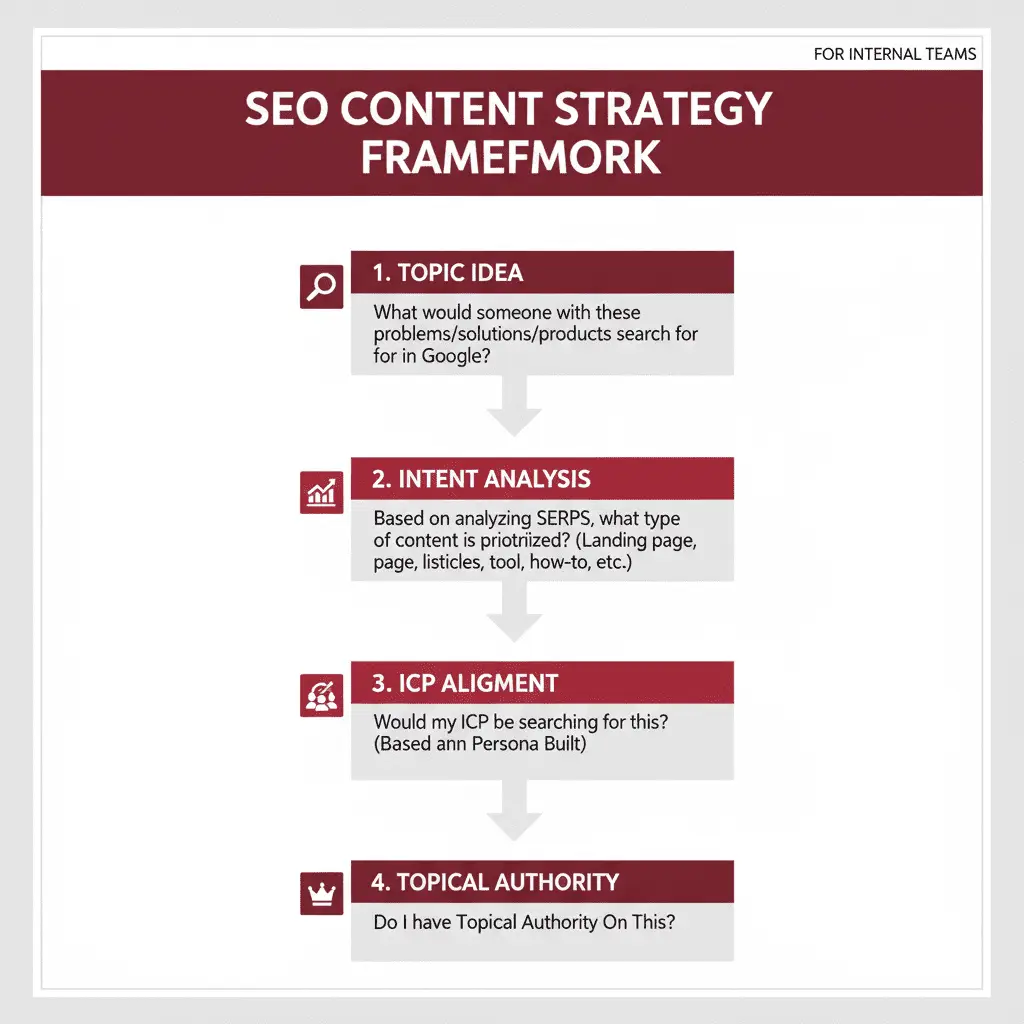
Before you take any initiative on your SaaS keyword research, you need to identify who exactly you are targeting.
You need to identify your core personas. Who are you trying to target with your content? What are their pain points? What solutions are they actively searching for?
You don’t have to limit yourself to just one persona either. You can have multiple ICP’s based on your product features. But having these clearly defined gives you a focus area for your keyword research and helps you understand what type of topics and tone of voice you should be using in your content
Once you have this foundation, you can begin identifying the specific keywords and search patterns that align with each persona’s journey to lay out your SaaS SEO strategy.
Step 2: Core Keyword Research
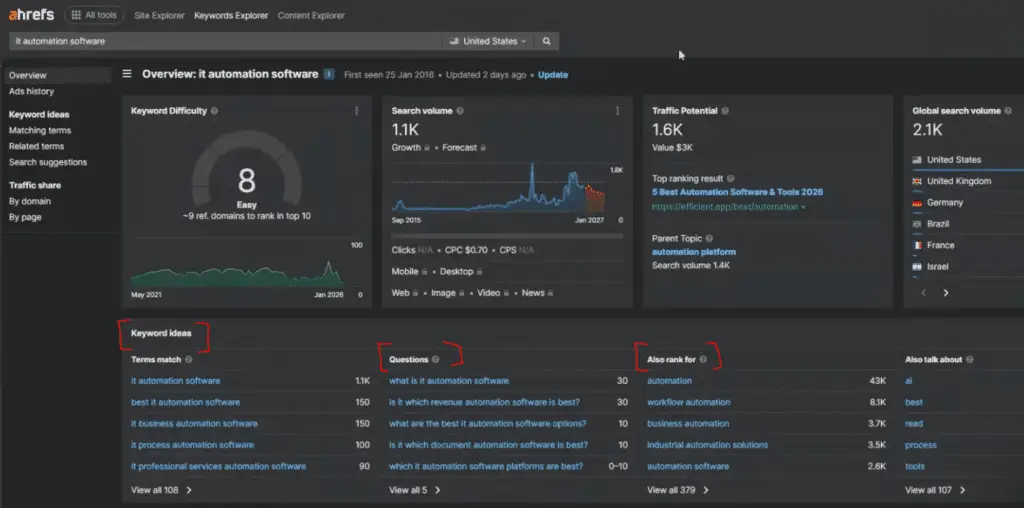
Alright, now that you know who you’re targeting, it’s time to actually start your keyword research. But here’s where most SaaS companies make their first big mistake: they open up a keyword tool and just start searching random terms hoping to find something with low keyword difficulty and decent volume.
That’s not how effective SaaS keyword research works.
Instead, you want to start with your core product features that directly solve your ICP’s pain points. Remember those personas we mapped out? Now we’re reverse engineering what they would actually search for when they need your solution.
This will allow you to get insights for keyword analysis for saas keywords to find and map software keywords that have high intent.For a more general overview of the keyword research process, check out my complete guide on how to do keyword research for SEO.
Step 3: The Bottom-Up Funnel Strategy for SaaS Keywords
Here’s where most SaaS companies completely mess up their content strategy: they start at the top of the funnel.They create a bunch of “ultimate guides” and “what is…” blog posts targeting long-tail, low-competition keywords because they think it’s the easiest way to get quick wins. And yeah, you might rank faster for those keywords. But they don’t convert.
Bottom-of-funnel keywords are where people have high commercial intent. They know they have a problem, they know they need a solution, and they’re actively evaluating software. These are your money keywords.
When you start here, you’re:
- Building topical authority around your core product features first
- Getting in front of people ready to convert (faster ROI)
- Creating a foundation that makes ranking for middle and top-funnel content easier later
The main goal is to target topics not keywords, and interlink them to cover all aspects of the topic of your specific features or products. This will help close the gap against competitors and be included within every stage your potential ICP would be searching for.
Study from Revenuezen states modern B2B buyers complete 67% of their journey digitally before engaging with sales teams, consuming an average of 13 pieces of content during their research process
Step 4: Competitor Keyword Analysis to Accelerate Your Keyword Research
Don’t reinvent the wheel. If your competitors are already ranking for relevant software keywords, you can reverse engineer their entire strategy in about 20 minutes using an SEO competitive analysis.
How to Extract Competitor Keywords
Find 3-5 direct competitors with similar product features. Plug them into Ahrefs or SEMrush and look at their organic keywords.
Let’s use Console.com vs. Resolve.io as an example. Both offer similar IT automation features. Resolve.io has a similar domain rating (DR 52) but ranks for 10x more keywords.
Why? They created dedicated landing pages for every single product feature.
In Ahrefs, go to their “Organic Keywords” section. You’ll see exactly what keywords they rank for and which specific URLs are driving that traffic.
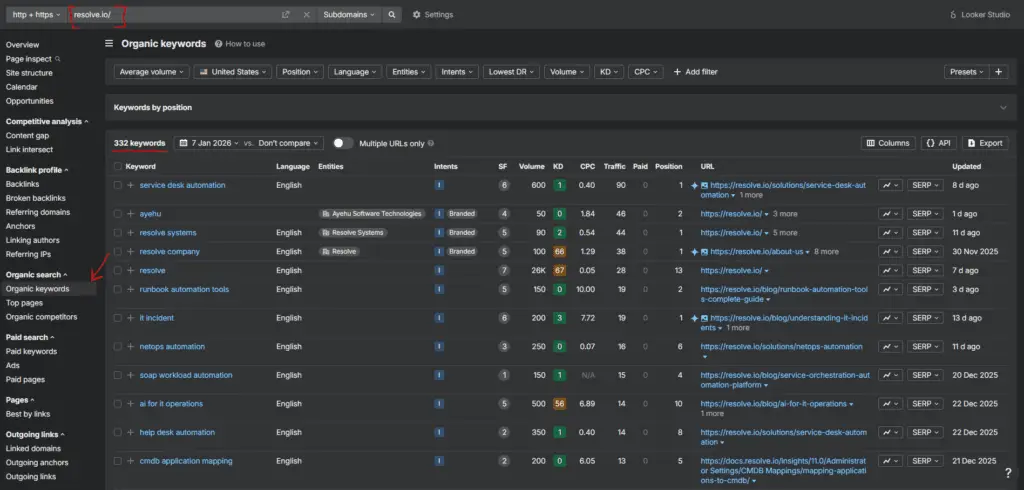
For Resolve.io, they’re ranking for:
- “Help desk automation” (480 searches/month) – dedicated landing page
- “Password reset automation” (90 searches/month) – dedicated landing page
- “IT ticketing automation” (210 searches/month) – dedicated landing page
Console.com doesn’t have optimized pages for any of these, even though their product does the exact same thing.
What to Look For
When analyzing competitors for B2B SaaS keyword research, document:
- Which keywords they rank for that you’re missing
- Their landing page structure and content approach
- Keyword gaps where they’re NOT ranking (your opportunity)
- Secondary keywords they’re naturally including
This gives you a ready-made list of proven keywords worth targeting, without months of trial and error.
Step 5: Building Topic Clusters Across the Entire Funnel
Now that you have your keywords from research and competitor analysis, it’s time to organize everything into topic clusters. This is how you actually build topical authority.
The Topic Cluster Framework
A topic cluster consists of:
- 1 Pillar Page (BOFU): Your main landing page targeting a core product keyword
- 3-5 Cluster Posts (MOFU/TOFU): Supporting content that links back to the pillar
Let’s map this out for Console.com using “IT automation software” as the pillar.
Pillar Page (BOFU):
- Target keyword: “IT automation software”
- Secondary keywords: IT business automation software, workflow automation for IT processes, IT automation solutions
- Page type: Landing page (2,000+ words)
- Goal: Convert visitors evaluating software
Cluster Content (MOFU):
- “IT Service Desk Automation: Complete Guide with Examples” (1,200 words)
- “Help Desk Automation Best Practices for IT Teams” (1,000 words)
- Internal links back to pillar page
Cluster Content (TOFU):
- “How to Build an Automated Ticketing System” (1,200 words)
- “5 Ways to Reduce Manual IT Tasks” (900 words)
- Internal links to MOFU guides and pillar page
Content Creation Best Practices
When creating this content, analyze what’s already ranking. Look for content gaps in top-performing pages, what are they missing that you can add?
Include keywords naturally without stuffing. Your content should read authentically, not like AI-generated fluff. Differentiate by adding real examples, screenshots, or unique insights competitors aren’t covering.
Learn more about how to write SEO contentthat ranks and converts.
Scaling Your SaaS Keyword Research Strategy
Repeat this exact process for every core product feature. If you have help desk automation, IT support automation, and service desk automation as separate features, each one gets its own topic cluster.
Prioritize based on your ICP’s biggest pain points first.
Need Help Implementing Your SaaS Keyword Strategy?
Keyword research is just the starting point. If you want a comprehensive SEO strategy that drives actual conversions, not just traffic, I can help.
As a SaaS SEO consultant, I work with SaaS companies to build topical authority, optimize for bottom-funnel conversions, and scale content that ranks across the entire customer journey. Let’s talk about accelerating your organic growth.
SaaS Keyword Research Frequently Asked Questions (FAQ)
What’s the best keyword research tools for the SaaS industry?
Ahrefs is my go-to for SaaS keyword research because it has the most accurate keyword difficulty scores and search volume data, which matters when you’re evaluating software keywords with commercial intent. The “matching terms” feature is also great for finding semantic variations and secondary keywords quickly.
SEMrush is a solid alternative, it has better competitor analysis features and works well for B2B SaaS keyword research if you’re doing deep competitive dives. If you’re bootstrapping or just starting out, Google Keyword Planner is free and surprisingly useful for finding topic ideas and search volume estimates.
Honestly, the tool matters less than your strategy. You can find great keywords with any of these if you’re starting bottom-of-funnel and mapping keywords to your ICP’s actual pain points.
How do I perform keyword research for saas products?
Start by defining your ICP personas and their pain points. This tells you what they’re actually searching for. Then use tools like Ahrefs, SEMrush, or Google Keyword Planner to find your core product keywords
Focus on bottom-of-funnel keywords first where people have high buying intent, not just low-competition fluff that won’t convert. Analyze the SERP to match content type to search intent, are landing pages or blog posts ranking?
Next, do competitor research to see what software keywords similar SaaS companies are targeting successfully. Finally, organize everything into topic clusters with one pillar page (your main product landing page) and supporting MOFU/TOFU content that internally links back.
How to do keyword research for saas blog focused content?
For SaaS blog content, focus on middle and top-of-funnel keywords where people are researching solutions or solving problems, not ready to buy yet. Typically these are long tail keywords that have more of an informational intent.
Which tools help with keyword research for saas?
Ahrefs and SEMrush are the best paid options for SaaS keyword research. Ahrefs has more accurate keyword difficulty data, while SEMrush excels at competitor analysis. If you’re on a budget, Google Keyword Planner is free and works well for finding topic ideas and search volume, though the data isn’t as detailed.
All three can help you find software keywords effectively if you’re using the right strategy.
Common SaaS SEO Keyword Research Mistakes
The most common keyword research mistakes done within SaaS SEO is focusing on keywords based on keyword difficulty and volume. You need to approach it from more of a topical level and interlink your content to establish yourself as an authority. Especially if you are a SaaS Startup with no domain authority for example.
Understanding how important SEO is in a SaaS business will help you prioritize these efforts correctly.
