

Most B2B companies approach SEO the same way they approach B2C and wonder why they’re not seeing results.
B2B SEO requires a completely different strategy.
Your buying cycles are longer, your decision-makers are more sophisticated, and your keywords have lower search volumes but infinitely higher value.
A single organic lead from the right keyword can generate $50K+ in ARR. But only if you’re targeting the right terms, creating content that converts multiple stakeholders, and measuring what actually drives pipeline.
This guide breaks down the exact B2B SEO strategy that helps companies go from zero organic visibility to predictable pipeline generation in 6-12 months.
What is B2B SEO?
B2B SEO is the practice of optimizing your website and content to rank in search engines for keywords that your target business buyers are searching for. Unlike B2C SEO, which focuses on high-volume consumer searches, B2B SEO targets decision-makers researching solutions for their companies.
The biggest difference? Complexity.
B2B purchases involve multiple stakeholders, often 6-10 decision-makers for enterprise deals. Your CFO cares about ROI, your CTO wants technical specs, and your end users need to understand implementation. Each persona searches differently and needs different content.
B2B buying cycles are longer. A consumer might search for “best running shoes” and buy within an hour. A B2B buyer searching “enterprise CRM for fintech” will research for 3-6 months before making a decision.
This creates unique challenges:
Low-volume, high-intent keywords dominate B2B. A keyword with 50 monthly searches might generate more revenue than a B2C keyword with 50,000 searches. Traditional SEO tools often dismiss these as “not worth targeting.”
Thought leadership matters more. B2B buyers want to see expertise, case studies, and proof that you understand their specific problems. Generic content doesn’t convert.
The sales funnel is non-linear. One person might discover you through a top-of-funnel guide, share it with their team, and three months later someone else searches for your product directly. Attribution gets messy, but the impact is real.
Most B2B companies make the mistake of ignoring SEO because “our buyers don’t search” or “the volume is too low.” The data shows otherwise. 89% of B2B buyers use search during their research process, and organic search influences 40%+ of B2B pipeline when measured correctly.
The question isn’t whether B2B SEO works. It’s whether you’re executing a B2B SEO strategy that accounts for these unique dynamics.
The 7-Step B2B SEO Strategy Framework
1. Map Your Buyer Journey Before You Touch Keywords
Most B2B SEO strategies fail at step one: they start with keyword research before understanding how their buyers actually make decisions.
Here’s the right approach: Map out every stakeholder involved in your buying process and what they care about at each stage.
For a B2B SaaS company selling to mid-market, you might have:
- Champion (Product Manager): Searches for solutions to specific pain points
- Influencer (Engineering Lead): Evaluates technical requirements and integration capabilities
- Decision Maker (VP or C-level): Focuses on ROI, risk, and strategic alignment
- End Users: Care about usability and day-to-day functionality
Each persona searches differently. Your champion might search “how to reduce customer churn in SaaS” while your decision-maker searches “customer retention platform ROI.”
Map the 3-stage B2B buying process:
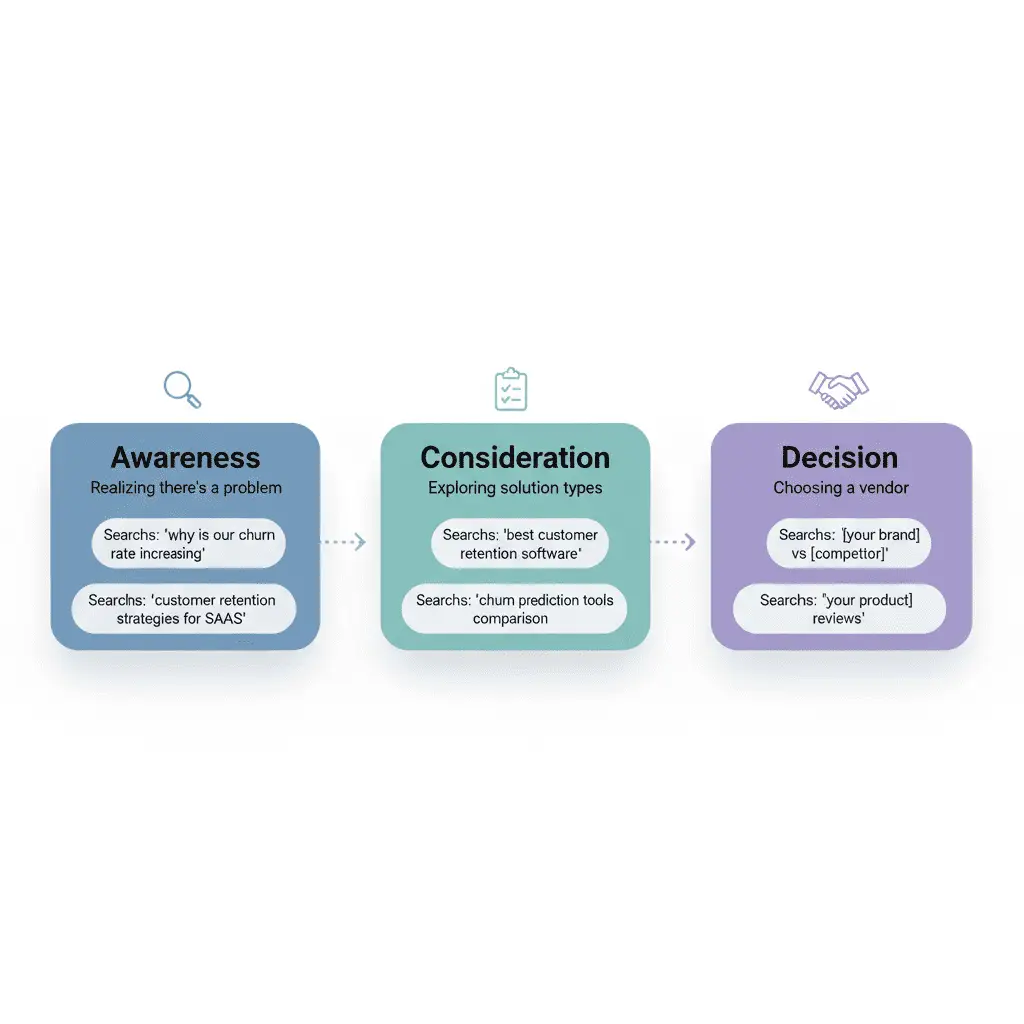
Awareness stage: Buyers recognize they have a problem but haven’t identified solutions. They search for educational content like “why is our churn rate increasing” or “customer retention strategies for SaaS.”
Consideration stage: Buyers know the solution category and are evaluating options. Searches include “best customer retention software” or “churn prediction tools comparison.”
Decision stage: Buyers have shortlisted 2-3 vendors and need final validation. They search for “[your brand] vs [competitor]” or “[your product] reviews.”
Most companies create content for only one stage, usually awareness. The revenue comes from covering all three.
Why traditional buyer personas fail: They’re too static. A VP of Sales searches differently when they’re casually browsing LinkedIn (awareness) versus actively evaluating vendors (decision). Focus on search behavior and intent, not just demographic details.
2. Target Bottom-Funnel Keywords First
Here’s the counterintuitive truth: Don’t start with top-of-funnel content. Start with bottom-of-funnel keywords that drive revenue now.
Why? BOFU keywords have three advantages:
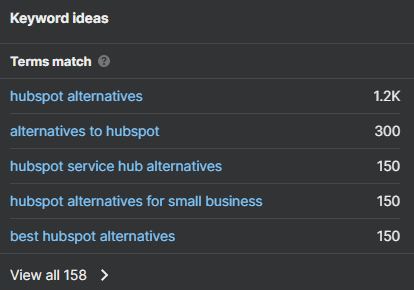
They convert faster. Someone searching “alternative to [competitor]” is ready to buy this month. Someone searching “what is customer retention” might buy in 18 months or never.
They prove ROI quickly. Most B2B executives are skeptical of SEO because they’ve seen agencies chase vanity metrics. When you rank for “best [solution] for [industry]” and start generating demos, you earn credibility to invest in longer-term plays.
They inform your content strategy. You’ll learn exactly what objections, use cases, and comparisons matter to buyers intelligence that makes your TOFU content better.
How to identify high-intent commercial keywords:
Look for these patterns:
- Product category + intent modifiers: “enterprise CRM software,” “B2B marketing automation platform”
- Comparison keywords: “[solution] vs [solution],” “best [category] for [industry/use case]”
- Alternative keywords: “alternative to [competitor],” “[competitor] competitors”
- Implementation keywords: “[solution] integration,” “how to implement [category]”
The striking distance opportunity: Use tools to find keywords where you rank positions 11-20. These are your fastest wins. A few strategic content updates and backlinks can move you to page one within weeks.
For B2B SaaS companies, focus especially on solution-specific search terms that include your use case or industry. “Project management software” has 40,000 monthly searches but converts terribly. “Project management software for construction companies” has 200 searches but those are your exact buyers.
3. Build Your Top-of-Funnel Content Engine
Once you’ve secured bottom-funnel rankings and proven ROI, scale with strategic top-of-funnel content.
The key word is strategic. Random blog posts don’t drive B2B pipeline. You need a hub and spoke content architecture built around business problems your ICP actually faces.
Here’s how it works:
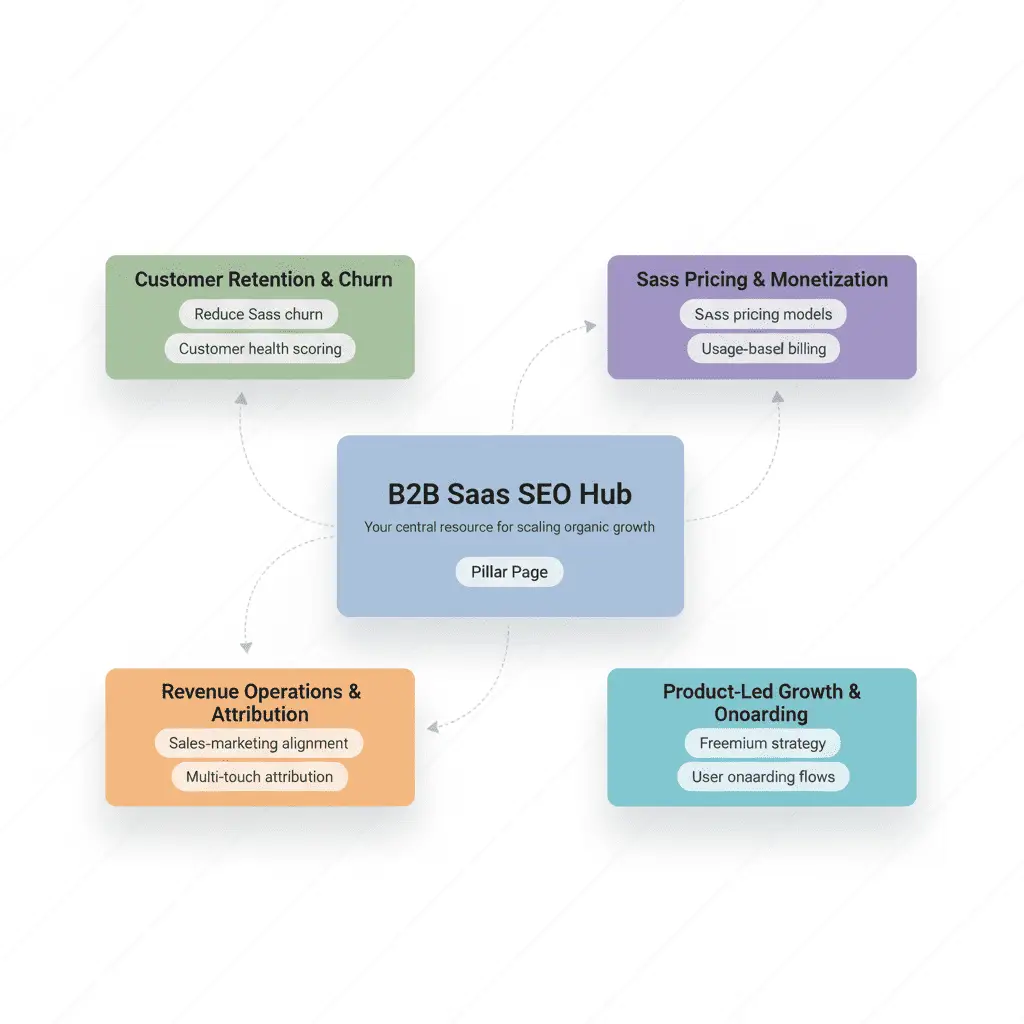
Identify 3-5 core topics (hubs) that represent major pain points for your target customers. For a B2B SaaS SEO strategy, these might be:
- Organic customer acquisition
- SEO for long sales cycles
- Content marketing for technical products
- B2B keyword research methodology
- Technical SEO for SaaS platforms
For each hub, create:
- One comprehensive pillar page that covers the entire topic at a strategic level
- 8-12 supporting articles (spokes) that dive deep into specific subtopics
- Internal linking from every spoke back to the hub, and from the hub to all spokes
This architecture does three things:
Establishes topical authority. Google sees you as an expert in these specific domains, not a generic content farm.
Captures traffic at every stage. Your pillar page ranks for the broad topic, your spokes capture long-tail variations.
Guides buyers through their journey. Someone who lands on “how to calculate customer acquisition cost” can discover your pillar page on “B2B customer acquisition strategy” and eventually find your product pages.
Content formats that actually work for B2B:
Ultimate guides: Comprehensive, bookmark-worthy resources that become go-to references in your industry. These earn backlinks naturally because they’re genuinely useful.
Frameworks and methodologies: B2B buyers want structured approaches, not generic tips. Give your framework a name, make it visual, and watch it get shared.
Calculators and tools: Interactive content that solves a specific problem. CAC calculators, ROI tools, audit checkers. These convert exceptionally well and earn links.
Shoulder topics are critical. These are adjacent to your product but not directly about it. If you sell marketing automation, content about sales enablement, RevOps, or customer data platforms attracts your same ICP without competing with your own product pages.
One thing to note is that creating content that actually ranks requires optimization, not just good writing.
Each piece needs proper keyword targeting, internal links to related content, schema markup, and a promotion plan. Budget hours per high-quality piece when you account for research, writing, editing, and promotion.
4. Optimize Your Product and Service Pages for Search Intent
Your product pages are often your highest-value pages for SEO and the most neglected.
Most B2B SaaS companies optimize their blog but leave product pages as thin, conversion-focused landing pages with 200 words and no search visibility. You can have both conversion optimization and SEO.
Technical product page SEO fundamentals:
Include content that explains:
- What the product does (and doesn’t do)
- Who it’s for (specific use cases and industries)
- How it works (high-level, with details available deeper)
- Why it’s different (unique value props with proof points)
- Common objections (price, implementation, integrations)
Use your target keywords naturally in:
- H1 (one time): “Enterprise Customer Data Platform for B2B SaaS”
- H2s (2-3 times): “How Our CDP Works,” “CDP Integrations for B2B Companies”
- Body content (5-8 times distributed naturally)
- Meta description: Include primary keyword and clear value prop
Handling low-volume product keywords: Your product might have a keyword with only 50 monthly searches. Create the page anyway. In B2B, those 50 searches might represent 50 directors at target accounts, each worth $100K+ in potential ARR.
Schema markup for B2B SaaS is under-utilized. Implement:
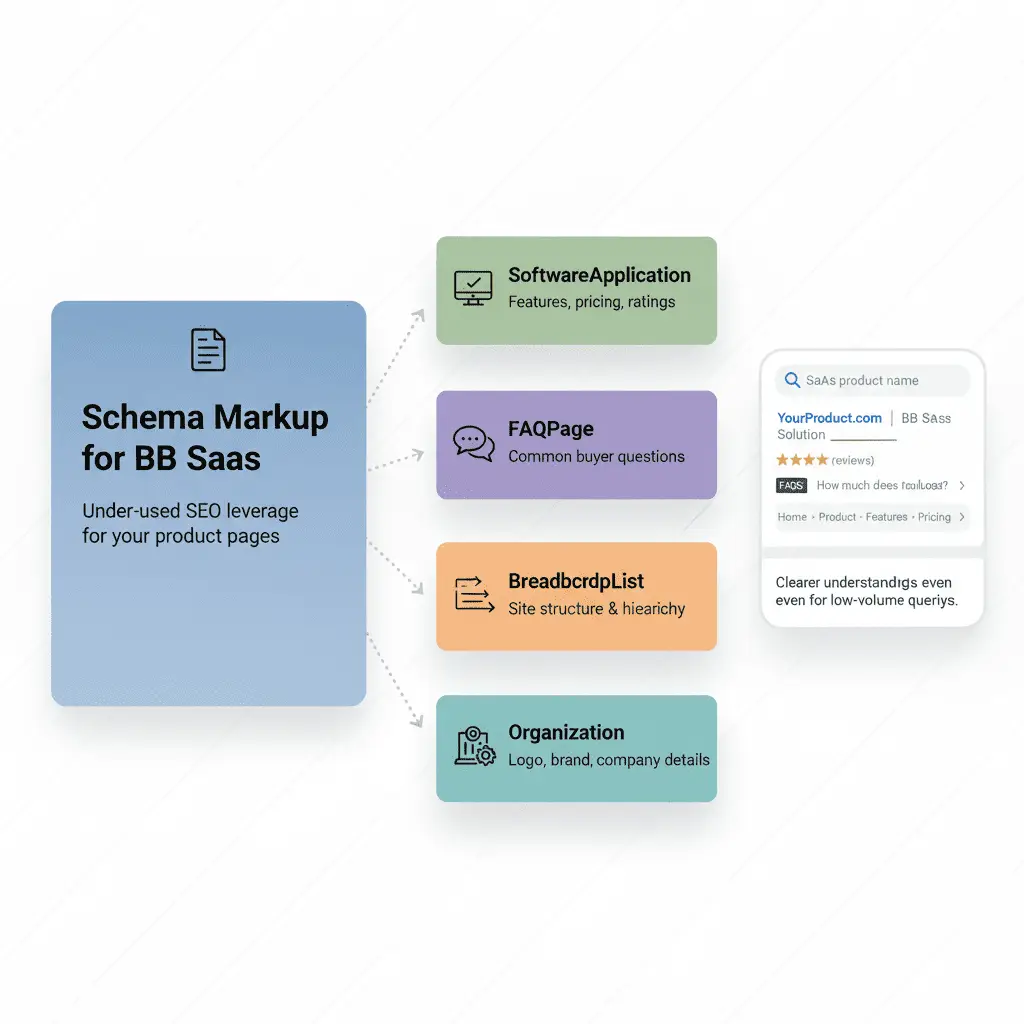
- SoftwareApplication schema with features, pricing, and ratings
- FAQ schema for common questions
- BreadcrumbList schema for site structure
- Organization schema with your logo and company details
This helps Google understand your product and can earn rich results even for low-volume queries.
Internal linking strategies for product pages:
Link FROM product pages TO:
- Related blog content that targets top-of-funnel keywords
- Case studies for your product’s use cases
- Comparison pages for competitive terms
Link TO product pages FROM:
- Blog posts that mention solutions (contextual CTAs)
- Pillar content that covers your product category
- Use case pages and industry pages
The goal: Make product pages hubs in your content network, not dead ends. This distributes authority and creates natural paths from educational content to commercial pages.
5. Execute a Strategic Link Building Campaign
B2B link building is fundamentally different from B2C. You’re not trying to go viral or get links from every blog. You need relevant, authoritative links from sites your buyers trust.
Why B2B link building is different:
Your target publications have smaller audiences but higher influence. A link from TechCrunch might drive traffic, but a link from an industry trade publication drives credibility with your exact ICP.
Quality matters exponentially more than quantity. Ten links from relevant B2B publications beat 100 links from generic guest post sites. Google evaluates relevance, and your buyers actually click through from industry sources.
Digital PR for thought leadership:
The most effective B2B link building strategy is becoming a quoted expert. Respond to journalist queries on platforms like HARO, Qwoted, and SourceBottle. When your CEO or technical leaders are quoted in industry publications, you earn editorial links and brand credibility.
Launch original research or data studies. Survey your customer base, analyze industry trends, or share proprietary benchmarks. Industry publications love original data and will link to the source.
Creating linkable assets:
Build tools and calculators that solve real problems. These earn links naturally because other sites reference them as resources. An ROI calculator might earn 50+ links over time if it’s genuinely useful.
Publish comprehensive industry reports or state-of-the-industry guides. These become reference materials that earn sustained link velocity over years.
Partner and integration page strategies:
If you integrate with other platforms, create detailed integration guides. Partner with integration partners to link to each other’s guides. This is natural, relevant, and valuable for users.
Your partners’ customers are often your ICP. Co-create content, co-host webinars, or launch joint research that earns links to both brands.
Guest posting that actually works:
Most guest posting is spam. The B2B approach: Target 5-10 publications where your buyers actually spend time. Pitch highly specific, expert-level content that their audience can’t get elsewhere. Don’t ask for author bio links, earn in-content contextual links by being genuinely valuable.
One guest post in a tier-1 industry publication beats 20 posts on generic marketing blogs.
6. Optimize for Answer Engine Optimization (AEO) and AI Citations
Search is evolving beyond the traditional “10 blue links.” ChatGPT, Perplexity, and SearchGPT now answer questions directly and they cite sources. If your content isn’t structured for AI citations, you’re invisible in the future of search.
Understanding AEO vs. traditional SEO:
Traditional SEO optimizes for ranking in a list of results. AEO optimizes to BE the answer. When someone asks ChatGPT “what is the best B2B SEO strategy,” you want your content cited in the response.
The difference is structural. AI engines prefer content that:
- Directly answers questions in clear, quotable formats
- Uses structured data and schema markup
- Demonstrates expertise and credibility through entity optimization
- Provides comprehensive coverage without fluff
How AI engines surface B2B content:
They look for authoritative signals, citations from other reputable sources, author credentials, and domain authority in specific topics.
They favor structured formats: Numbered lists, bullet points, definition sections, comparison tables, and FAQ formats all get cited more frequently.
They need context. AI engines understand entities (people, companies, concepts). Being recognized as an entity in your domain increases citation probability.
Structuring content for AI citation inclusion:
Use question-based H2s and H3s that match how people ask questions. Instead of “Keyword Research Methods,” use “How Do You Find B2B Keywords with Low Competition?”
Provide direct, quotable answers immediately after questions. Answer in the first 2-3 sentences, then expand with details.
Implement FAQ schema markup. This explicitly tells AI engines which parts of your content answer common questions.
Featured snippet and People Also Ask optimization:
Target question-based keywords. Use tools to find “how,” “what,” “why,” “when” variations of your core topics.
Answer in 40-60 words immediately under the question. This is the ideal length for featured snippets.
Use formatting that Google favors: numbered lists, bullet points, tables, and definition formats (bolded term followed by clear explanation).
Schema markup for AI understanding:
Implement Article schema with author credentials, publish date, and comprehensive metadata.
Use FAQPage schema for any Q&A content. This directly feeds into Google’s Knowledge Graph and AI training data.
Add HowTo schema for process-based content. This increases visibility in both traditional and AI search results.
The future of B2B SEO includes traditional rankings AND AI citations. Optimize for both.
7. Create a Measurement Framework That Ties to Revenue
Most B2B SEO strategies fail at measurement. Tracking rankings and traffic is useless if you can’t connect it to pipeline and revenue.
Here’s how to build a measurement framework that proves ROI to leadership:
Setting up proper attribution:
Implement closed-loop attribution that tracks the full customer journey. When a lead converts to a customer, you need to see if organic search played any role, even if it wasn’t the last touch.
Use multi-touch attribution models. In B2B, the average buyer has 8-12 touchpoints before converting. Organic search often assists early in the journey, even if paid or direct closes the deal.
Tag organic traffic by funnel stage. Create separate segments for TOFU (blog traffic), MOFU (comparison pages), and BOFU (product pages). This shows which content types drive different outcomes.
Tracking assisted conversions:
Set up Google Analytics 4 to track assists. Configure custom explorations that show how organic search or AI search traffic contributes to conversions even when it’s not the last click.
Look at time-lag reports. B2B buyers might discover you organically, disappear for 3 months, then return via direct or branded search. Attribution windows need to match your sales cycle, often 90-180 days.
Calculating SEO’s contribution to pipeline:
Track these metrics by organic traffic source:
- MQLs generated: How many marketing qualified leads come from organic?
- SQLs generated: What percentage convert to sales qualified leads?
- Opportunities created: How much pipeline is influenced by organic search?
- Closed-won revenue: What’s the actual ARR from organic-sourced deals?
Calculate organic CAC: Total SEO investment ÷ customers acquired from organic. Compare this to paid CAC to show efficiency.
Proving ROI to leadership:
Show the compounding effect. Unlike paid channels where you rent traffic, SEO compounds. A blog post published today continues generating leads for years.
Report on share of voice in organic search. Track how many high-intent keywords you rank for compared to competitors. Growing share of voice predicts future pipeline growth.
Connect rankings to business outcomes. Don’t report “we rank #3 for keyword X.” Report “we now rank #3 for ‘enterprise CRM comparison,’ which generates 45 MQLs/month at $2,800 lower CAC than paid search.”
Benchmark against paid efficiency. Show organic cost per MQL, SQL, and customer compared to paid channels. For most B2B companies, organic delivers 40-60% lower CAC at scale.
The goal: Make SEO a predictable revenue channel, not a “nice to have” marketing initiative.
Conclusion: Building Sustainable B2B Organic Growth
B2B SEO isn’t about traffic, it’s about pipeline.
The companies that win with organic search understand this and build their B2B SEO strategies around revenue, not rankings. They target low-volume, high-intent keywords that actually drive deals. They create content that speaks to multiple stakeholders and guides them through complex buying cycles. And they measure what matters: contribution to pipeline and closed-won revenue.
The compounding nature of B2B SEO makes it one of the highest-ROI channels over time. Your paid campaigns stop generating leads the moment you pause spend. Your organic content continues driving pipeline for years.
Timeline expectations: Most B2B SEO strategies take 6-12 months to show meaningful results. The first 3 months are foundation building, technical optimization, keyword research, content planning. Months 4-6 are execution publishing content, earning links, and starting to see rankings. Months 7-12 are when you see real pipeline impact as more content ranks and the compound effect kicks in.
Next steps for implementation:
Start with bottom-funnel keywords to prove ROI quickly. Map your buyer journey and identify the highest-intent search terms for each stakeholder. Create or optimize product pages for these terms first.
Build your content hub and spoke architecture around 3-5 core topics. Start with pillar pages, then expand to supporting content that captures long-tail variations.
Implement proper measurement from day one. Set up attribution, define your metrics, and create a reporting framework that ties organic performance to business outcomes.
For B2B SaaS companies especially, organic search becomes your most efficient acquisition channel at scale. It reduces CAC, improves customer quality, and compounds over time but only when executed with a strategy built for B2B buying cycles.
Let’s Map Out Your SEO Opportunity
Every B2B SaaS company’s situation is different. What worked for a $5M ARR startup won’t be identical for a $50M growth-stage company.
That’s why I start every engagement with a strategic discovery call to understand:
- Your current organic visibility
- Your biggest growth barriers
- The opportunities your competitors are missing
- What success would look like for your business
From there, we map out the right approach.
Frequently Asked Questions
Why is SEO important for B2B?
SEO drives 40%+ of B2B pipeline when measured correctly, and organic leads have 40-60% lower CAC than paid channels at scale. B2B buyers conduct extensive research before making purchase decisions, 89% use search during their buying process.
Without organic visibility, you’re invisible during the critical research phase when buyers build their shortlists. Plus, unlike paid advertising, SEO compounds over time. Content you publish today continues generating qualified leads for years.
How to create a winning B2B SEO campaign?
Start by mapping your buyer journey and identifying keywords for each stakeholder at each stage. Target bottom-funnel keywords first to prove ROI quickly. focus on product comparisons, alternative searches, and solution-specific terms.
Build a hub and spoke content architecture around core topics your ICP cares about. Optimize product pages for search intent while maintaining conversion focus.
Execute strategic link building through digital PR, original research, and partner collaborations.
Finally, implement measurement that connects organic performance to pipeline and revenue, not just traffic.
How to track SEO ROI for B2B marketing?
Implement closed-loop attribution that tracks the full customer journey from first organic touch to closed-won deal. Use multi-touch attribution models since B2B buyers have 8-12 touchpoints before converting.
Track organic’s contribution to MQLs, SQLs, pipeline created, and closed-won revenue. Calculate organic CAC (total SEO investment ÷ customers acquired) and compare to paid channels.
Set attribution windows that match your sales cycle, typically 90-180 days for B2B. Report on organic’s contribution to pipeline, not just traffic and rankings, to show true business impact.
How to identify SEO priorities for a B2B startup?
Focus on bottom-funnel keywords first. Target product comparison terms, alternative keywords for competitors, and solution-specific searches that drive near-term revenue.
Optimize your core product pages before investing heavily in top-of-funnel content. Fix critical technical SEO issues such as mobile optimization, site speed, proper schema markup that prevent indexing. Build relationships with 3-5 industry publications for backlinks rather than trying to scale link building broadly.
Start with one content hub focused on your primary ICP’s biggest pain point rather than trying to cover everything.
How to use video content in B2B SEO strategy?
Video supports B2B SEO in three ways. First, embed videos on key pages to increase time on page and engagement signals, these are ranking factors.
Second, optimize video content for search by hosting on YouTube with keyword-optimized titles, descriptions, and transcripts, then embedding on your site.
Third, use video to answer common questions that appear in People Also Ask and featured snippets. Create short explainer videos for product features, implementation guides, and customer success stories. Transcribe videos and include the text on page. This gives Google content to index while providing value to users who prefer reading.
